All The News Thats Fit To Print
RAF Hendon - How Was It For You?
Membership and How to Keep It
Isnt it Time You Thoughtabout It?
It has been a quiet few months for me on the INCOSE front. I did notmanage to get to Hendon, and so far as I am aware there were no other activities. I amlooking forward to the International Symposium in Vancouver. There will be a fair bit oftime spent working on INCOSE 99 matters, whether in committee, observing (and probablyhelping) behind the scenes or manning the INCOSE 99 stand.
The result of my quiet few months is that I am entirely dependent onother peoples contributions to the Newsletter. Compared with previous issues thisone is a bit thin. No regional meetings have been held (apparently) or any planned. TheAGM will presumably be held in October/November, but I have been given no details. Thereare even rumours of a European event towards the end of the year.
As with any publication, the Newsletter has to have a deadline even ifit is a fairly flexible one. Old news is not news at all. So I am publishing and willhopefully not be damned. I look forward to any contributions to the next Newsletter whichI plan to publish around October/November. News, views, suggestions, short technicalpieces, comments they are all welcome.
I hope to see plenty of the UK Chapter taking part at Vancouver andvolunteering to get involved with INCOSE 99. From what I have seen from past internationalsymposia there will be plenty to do. The next 11 months will certainly not be as quiet asthe last three.
Pete Lister
The RAF museum at Hendon played host to the fourth INCOSE UK ChapterSymposium, Systems Engineering A Matter of Choice, (Monday 1st June to Wednesday3rd June 1998). The first two days of the event were dedicated to papers relating to themain symposium theme, while the third day, in response to popular demand, was set asidefor a series of tutorials.
Proceedings commenced with an opening address from the UK president MrAllen Fairbairn. Mr Peter Brook from DERA then gave the Keynote address, providing apotted history of INCOSE as an organisation and pointing to the growth in maturity of theorganisation, or as he put it the coming of age of INCOSE. The firstpublication of the INCOSE journal, which will be issued free to all INCOSE members, wasannounced, as was the INCOSE fellowship, to be awarded to individuals who have made amajor contribution in the field of Systems Engineering.
In keeping with the main theme of the conference, the first mainsession of the day contained three papers looking at issues in relation to Choice and theSystems Engineering process. After lunch (and a rather good fruit salad) the delegatessplit into two streams, Stream A looking at Requirements Engineering, and Stream Bfollowing on from the first session and exploring issues in relation to choice in thefuture. I attended the former session, as did about 70% of the delegates illustrating thatthe complex and problematic area of requirements and requirements process improvement isstill an issue high on peoples agendas.
Having indulged and enjoyed my preferred option for the day, I wassomewhat reticent that I had had to make a choice, and subsequently missed a number ofinteresting talks in Stream B. In particular, the talk given by Wing Lam from theUniversity of Hertfordshire on Managing Change in Technological Environments, was highlyrecommended by those in attendance.
The conference dinner was held on the Monday evening in the Battle ofBritain Museum an absolutely superb setting on a par with the National RailwayMuseum at York. Drinks were served between 7pm and 8pm, after which we were lead to ourseats through an old flying boat (the exact name and age of which escapes me at themoment). We were then dined and further wined before being treated to an after dinnerspeech by Lt General EFG Burton, Deputy Chief of the Defence Staff (Systems). In his talk,Lt General Burton (speaking as the head of all procurement for the MoD) strongly advocatedthe transition to a systems based approach to procurement, through the Smart Procurementinitiative. This rounded off a very enjoyable evening.
On Tuesday morning all the delegates were merged back into a singlestream as the main theme of the conference proceeded. The morning saw the issue of choicefurther explored, whilst the afternoon marked the first tie up with the Association ofProject Managers in a session entitled Project Management and Systems Engineering. Thesefinal papers demonstrated the synergy that exists between the two bodies, and hopefullymarks the start of an ongoing and beneficial relationship.
Five tutorials were held on the final day, and the overall numbersattending these were surprisingly high. These included Professor Derek Hitchins talking onSystems Engineering and the Pyramids, and Paul Hicks from Ascent logic talking on the useof tools as a mechanism for covert process enforcement. Dr H-P Hoffman from I-Logix inc.USA gave a tutorial on speeding up Systems development and Dr Rob Collins of Entelecheiagave a tutorial entitled The Fast Lane to Systems Engineering. I elected to attend atutorial on Risk Management that was run by Ken Newland from Quintec Associates Ltd., andI was not disappointed. The half day tutorial presented an excellent overview of the mainprinciples and issues within Risk Management, and highlighted avenues for furtherinvestigation.
In conclusion, this years INCOSE symposium reflects the comments of thekey note speaker INCOSE is coming of age. This was reflected in the technicalcontent and balance of papers and the overall organisation of the event. The whole packagewas rounded off by the superb venue. The RAF museum on its own is truly worth a visit,with exhibits ranging from what looked like a metal bath tub with an engine on the back(well almost), to the only non-service Tornado in the world (the rest I was reliablyinformed being either in service or scrap). The flight simulator, available for publicuse, and offering three flavours of flights of which we partook of two, the World War Idog fight and the Tornado flight (which only served to fuel the desire to experience thereal thing) provided a source of intense amusement. A three screen computer simulation ofa theoretical Euro fighter mission also raised the blood pressure a little.
Jane Smith, University of York
If you are attending the INCOSE 98 International Symposium in Vancouverlater this month, and particularly if you are willing to do an hour or sos duty onthe INCOSE 99 stand in the exhibition, please let Ian Sedgley know at or Phone 01772-855551 or Fax01772-855855.
Fifty four of you returned a questionnaire giving your views on ourevent at Hendon. Several did not answer all questions as they had not taken part in all ofit. Your views as shared with us are one of the ways we rely upon to further improve theevents.
The responses indicate that most of you were very happy with most ofthe event. I feel that I can say this because against the twelve questions asked allreceived a majority in either the good or very good boxes. The items receiving a majorityin the Very Good were, Suitability of Venue, and Symposium dinner.
I will look further at the list of serious suggestions made as to whatchanges should be made for the future. Every year we consider the feed-back that we obtainfrom the questionnaires when planning the next Symposium. It is your event and it is yourparticipation that makes the event a success. I will not however spend too much time onthe comment which read "Presenters should make more noise to help keep usawake"!
John Mead.
To all new members, whether joining as part of attendance at our recentHendon conference or by individual application - Welcome.
Our procedure for handling membership applications is fairlystraightforward but not necessarily very quick. So it may be a while before you receive amembership number.
Apart from those that joined as part of the Symposium fee otherindividuals may join either by sending $60 and a completed application form to the CentralOffice in the USA, or £40 and an application form to me. These figures are for twelvemonths of a year that always starts on 1st June and applies to those joining in June, Julyand August. During the next three months it is $45 or £30 and so on for each quarter.
Whichever way you choose to join your details go onto a data-base inthe UK and another in the USA and we endeavour to keep these in step. The US database isused to allocate and forward membership numbers, and to distribute various member itemssuch as Insight magazine, INCOSE Journal, information on international events andmembership renewal notices once a year in April. Our local data-base is used to distributeUK newsletters & other information which we think will be of interest to memberslocally.
Membership renewal notices are always issued from the USA in dollarsbut you may still pay here in local currency.
To those reading this Newsletter who have not joined, we enclose amembership application form in the hope that you will choose to join us. Alternatively, ifyou know someone else who should receive the benefits of membership pass the applicationonto them. If you have received this direct, but have not joined or renewed, I recommendyou do as there will not be many more free ones. Please complete an application form ifjoining for the first time.
John Mead
INCOSE 99 in Brighton is now less than a year away and the pace isbeginning to hot up! You should have received a copy of the INCOSE 99 leaflet that wasprepared for the recent Chapter Symposium in Hendon with this Newsletter so I wontduplicate that information. Please read my message carefully, book the dates and thenconsider if you can offer a paper and/or a tutorial, as described in the remainder of theleaflet.
I would like to take the opportunity to ask for your help. Like mostvoluntary organisations, INCOSE is heavily dependent on a relatively small group ofcommitted enthusiasts for much of its work. We are fortunate that we have an INCOSE 99Committee up and running. I am sure that we will need to expand our numbers as thesituation develops (hopefully, not a euphemism for when panic sets in!)If anyone wants to help or be put on a shortlist for the future, then please contact me.
However, I believe there is something that virtually ALL of you coulddo NOW that is not onerous but which could add significantly to the success of the event.It is no mean task that we have set ourselves - to achieve a minimum attendance of 600with at least 250 attending tutorials and with 50 exhibitors. I could say that the honourof the UK Chapter is at stake and, to some extent it is. A more pragmatic way of lookingat the challenge is to realise that we are planning what is surely the biggest gatheringof systems engineering practitioners that has ever been held in Europe - and why? - toshare the future together so that we can all learn from each other and applythat greater knowledge and skill in our daily activities. The technical programme is,inevitably, the main reason for most people to attend and a good delegate attendance isclearly a strong motivator for exhibitors to be there as well.
So, what am I asking you to do? The short answer is To help us inmarketing the event. INCOSE is not a profit-making organisation and we are tryingvery hard to keep the Symposium fees as low as possible. To be a success, we needconsiderable marketing effort and this is where you all can help. Can you help reach outand spread the word throughout Europe? If so, we would be very pleased to hear from you,with details of which country or organisations you have links with.
If you are able to act as information distributor withinyour organisation (or know who can), then please let us know. We will provide you withleaflets and press releases; all you have to do is get the information toeveryone who might be interested. In addition, if you are associated with other groups,e.g. Trade Associations or Government Agencies, please let us know if you are aware ofcontact points that might help us market in a focused (and hence, cost-effective) way. Ifyours is an organisation that appreciates the importance of good systems engineering andthe need always to be striving to improve its application, then perhaps you can see ifthere is a willingness to sponsor something in the event and/or send out INCOSE 99information as part of regular publicity activities. Perhaps your organisation will alsowant to be there in the Exhibition.
Please send your address, telephone, facsimile and e-mail details toJohn Mead, indicating what help you might be able to offer. If youre in a largeorganisation and are not able to reach it all, please indicate whichbits you can manage!
Finally, one of our biggest marketing challenges is to identify thoseareas where systems engineering is used but which are not yet represented in INCOSE. Thesearea might well not even use the term systems engineering but do it all thesame! If you can come up with some information to help us tell them about INCOSE and theInternational Symposium then PLEASE do so.
The majority of us ARE extremely busy and (over) committed but here isan opportunity to help INCOSE and, at the same time, help yourself and your organisation.Win, win!!
Peter Robson,
Chair, INCOSE 99 General Committee
Last in the series. Aw! I can feel myself choking up already. Those ofyou with staying powerthats all real systems thinkers, of coursewill beexpecting some real systems engineering models, as promised last time. Lets startwith some basics of classic systems engineering.
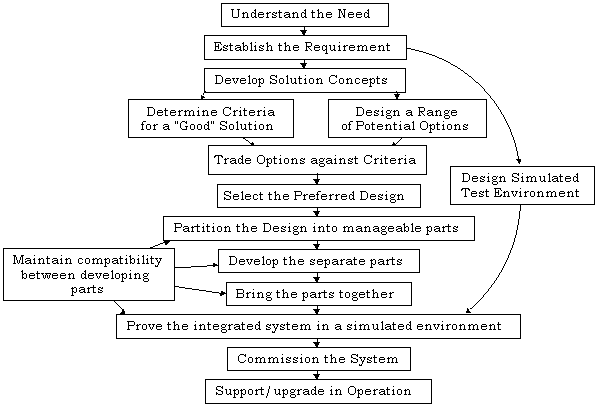
This diagram below pretty well says it all, as far as the classicapproach is concerned. Start at the top with Understanding the Need. Notice that it is notthe Want, but the Need. Theres a big difference.
I had to go to a Middle East country; the air force customer wanted acomputer system which would provide an up-to-date record of which aircraft were airborne,which were on the ground ready, being turned round and so on. Its known in the tradeas a State Board. I listened to the customer tell me what he wanted, and that evening Igot hold of some Perspex and chinagraph pencils. Next morning, on the customerswall, was the Perspex sheet marked up with one row for each aircraft, and one column foreach of the 6 different states each aircraft might be in.
The customer was delightedI had understood his need, and notpandered to his misconceptions about computer systems. Mind you, when I got back home, myboss was less enthusiastic. You dont have to be a rocket scientist to guess why.
Once the need is understood, and that might involve modelling,operations research, etc., then the Requirement can Established. Note the line at theright that leads directly to "Prove the integrated system in a simulatedenvironment". This tells you that the requirement is both for an end system to bedelivered and for the means to prove it prior to delivery. The simulated environment,generally dynamic, acts as a guard to ensure that all the design, development andmanufacturing work is sound, and that the end system will work in its operationalenvironment while interacting with other systems.
Next on the diagram is classic systems engineering problem solving:Develop Solution Concepts. This is the creative point. The Requirement describes the"Solution Space". Using experience, imagination and good old brain-power, avariety of Solution Concepts is synthesizedeach of which fills the Solution Space.Some solutions may be cheap. Some may be comprehensive. Some may use advanced technology.Some may use no technology. Some may be produced quickly, while others may take longer.
From these various concepts, a number of design options is developed inmore or less detail. At the same time, criteria are identified by which to choose thepreferred option. Criteria come partly from the requirement, and partly from theorganization, which has to manage technology, budget, quality, time scale and risk.Options are traded against criteria to produce the preferred design.Problemoptionscriteriatrade-off: the classic Systems Engineeringapproach to problem solving.
Up until this point, there has been no reduction, only synthesis. Theprocess now requires that the design be partitioned into manageable parts. There areseveral ways to do this, and choosing the wrong one can damage your project and profit.
There was much talk in Foresight of building integrated system. Boththe above methods create integrated systems, but of quite different natures and with quitedifferent costs and risks.
The classic Systems Engineering figure shows the parts being separatelydeveloped, while compatibility between their respective PCBs is maintained. Finally theparts are brought together, proved, commissioned and supported in operation.
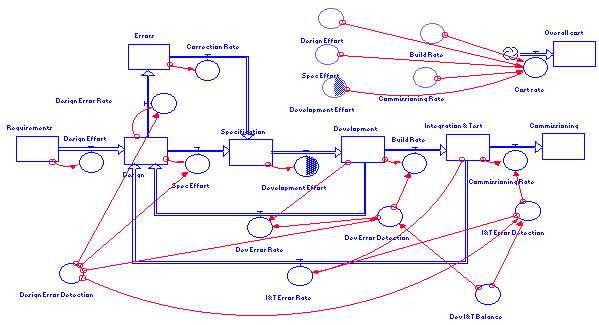
We can use STELLA to model this classic Systems Engineeringprocess. See the figure above. The model is designed to explore the effects of requirementerrors on the overall process duration and cost. Starting at left, a reservoir ofRequirements is examined in a design process which detects and corrects errors, andproduces a system specification. The specification drives development effort, which buildsthe parts. These are integrated and tested, and the proven whole is finally commissioned.Costs are accumulated at top right.
Some errors may remain in the specification, only to emerge as problemseither during development or during integration and test. Error detection performance isset at bottom left, and errors result in corrections, upper loop, or feedback, two lowerloops. The classic Systems Engineering process omitted feedback for simplicity; thesimulation cannot.
Running the model for different degrees of initial error detectionresults in the graph below, showing accumulated costs over time. As expected 100% errordetection gives the lowest cost and, judging by the point when the slope goes to zero, theshortest time, too. It should; no feedback gives minimum time and effort.

Other lines, at 10% spacing, show that the effects of leaving errors inthe requirements can be quite dramatic. Even at 90% detection, the project takes over 3times as long and costs some 80% more. Projects with even lower detection rates neverterminate.
So, by thinking about the classic systems engineering process wehave:
and I have recounted a tall tale into the bargainhow muchdo you pay for this Newsletter? Not nearly enough. Theyre giving it away!
Derek Hitchins