
INCOSE is going through a period of change, both for the organisationitself and the people that belong to it. Change is not always comfortable, but it is afundamental part of modern life. The engineering profession, more than any other, needs toembrace change and exploit the benefits that it brings.
INCOSE was formed in the US against a background of many largeaerospace and military projects being performed by over a dozen major companies. As aresult of the rationalisation of the aerospace and defence industry there are only reallythree major companies left, and the projects are fewer. Some of the current projects, suchas JSF, involve international collaboration.
Other industries are beginning to take an interest in SystemsEngineering, and the DoD, once the bastion of process standards for military products hasdecided that industry should be free to adopt appropriate commercial standards for SystemsEngineering. The rest of the world is also taking notice of Systems Engineering as aspecific engineering discipline.
Not surprisingly, some of the old tenets of Systems Engineering arebeing questioned, or at least re-evaluated against the needs of a broader customer base. Isubscribe to the view that new ideas are always welcome and we can always learn from them,but I can also understand that others find such changes hard to assimilate.
INCOSE is becoming more international in outlook as well as in name,but inevitably there are still those who mourn the ‘good-old-days’. INCOSEmembers are heavily involved the new ISO 15288 standard, which indicates an awareness ofinternational issues.
Membership is increasing, but there is a slightly worrying trend ofpeople joining and then leaving again. Clearly INCOSE has to be relevant to the needs ofthe membership. I was interested to note from discussions at the IWS that the US has asimilar ratio of ‘active’ members to ‘symposium attendees’ as the UK.Part of this has to do with ones outlook on life, but in today’s competitive worldthere is less time available within the confines of ‘the day job’ for the luxuryof thinking about things which do not directly assist with ones current dead-line. To bean active member requires an understanding boss, an appropriate job description or theinclination and the time to spend Sunday afternoon writing a newsletter.
The other main source of change within INCOSE is the increasingprofessionalisation of the services that INCOSE provides to its members. Some probablyfeel that this erodes the ‘gung-ho’ enthusiasm which has characterised theorganisation so far. In the long run, if we are to reach a wider membership, and if themembers have less time to spend managing the organisation, then this is the only way toprogress. Both the main INCOSE organisation and the UK Chapter have recognised this and,subject to the required funding being available, are contracting services to individualsand organisations.
So, we live in interesting times. We have reached this point because ofthe success of INCOSE, you don’t have growing pains unless you are expanding. Withgood management and the support of its members INCOSE could become a major force in theinternational engineering community. I for one want to be around to see it happen.
Pete Lister
It has not been the custom to report to the membership on each andevery Chapter Board meeting. This is supposed to be an interesting and lively Newsletterand Board Meetings are often far from being that! However, the two most recent meetingshave been very exciting and it is appropriate to tell the membership of the background andof the outcome.
The Chapter continues to bring off better and bigger events. Chaptermembers who attended the first INCOSE European Symposium at Noordwijk last November cantestify to that and the whole exercise was considered very useful in building confidencewith our American colleagues in looking ahead to Brighton 99.
The Chapter has taken a key role in the International growth plans ofINCOSE, not least because of the activities of Peter Brook, as a European Regionaldirector. The idea of a National Chapter, as opposed to local Chapters, has also emerged,as these things do, and the consequences of this realisation need to be fully worked out,particularly in relation to world regions (eg Europe) national Chapters and localChapters.
At the overall INCOSE level, it was thought that things were improvingin terms of our American colleagues coming to terms with recognising the way ahead for aWorld-Class organisation. INCOSE is going to publish a Journal, jazz up the Insight andgenerally tackle Internationalisation with a little more meaningful zest. There have alsobeen some moves to make the technical committees more international, eg appointing HeinzStower from the Netherlands as joint chair. Peter Lister's report from the Dallas JanuaryWorkshop will give members further insights.
However, it was also recognised by the Chapter Board how difficult ithad now become for members to contribute their diminishingly small spare time to gettinginvolved with the running of Chapter activities. All members want to benefit from theirINCOSE involvement but not all of us have the time consistently to devote to the minutiaeof running events, promoting, organising and, even, attending functions. Rather thanbemoan this, the Board accepted it as a fact of modern life. Recognising that companiesbenefit from having their staff as INCOSE members, it soon follows that corporatesponsorship is the logical means of acquiring the necessary resources that the Chapterneeds to sustain and grow its service to members, promote Systems Engineering and so on.GEC-Marconi had become the first non-US company to join the CAB (Corporate AdvisoryBoard), as advised at the 1997 AGM; together with BAe and DERA, they have now agreed to aformula for sponsoring UK Chapter activities directly.
Against a background of continuing success at home and abroad, but withminimal resources to call on, the following strategic outcomes were agreed. We envisagesubstantial growth and development of interest in Systems Engineering in the UK and ourbasis for seeking to develop this exponentially over the next five years or so is premisedon the following:
World-wide interest in Systems Engineering will grow, particularly if we are major players in that process. The UK within Europe has a great deal to contribute. The impending ISO standard should bring about much needed new thinking on aspects of Internationalisation and Chapter members have had, and still have an unprecedented opportunity to contribute to this through Stuart Arnold’s involvement.
In the UK, post Foresight interest in Systems Engineering is strong but nascent. Somebody has to act as catalyst and INCOSE, working with the other organisations has a vital role to play, as no other organisation has clear views on the subject.
Defence Procurement is undergoing radical change, with Systems Engineering and Project Management perhaps seen as a key strategic alliance to be developed in response. Peter Morris of the APM (Association of Project Managers) called it "The Forgotten Partnership" when he gave his keynote at our 2nd Symposium at Coventry, and so it is. We must do all we can to eliminate the "F" word.
In other Industries, projects continue to fail to meet expectations. Was anybody really surprised when the Channel Tunnel Rail Link project ran into trouble? Getting organised around requirements and taking a basic systems approach to the whole business proposition could make enormous differences, but how do we get the message across? Son of Foresight should help.
Brighton99 represents a considerable opportunity for INCOSE to marshal UK and European interest in Systems Engineering. The lead up and follow on periods are just as important as the event itself, both to make the event a real success and then to capitalise on it.
In fact, nothing sells more than SUCCESS!! There are success stories in Systems Engineering and there are many more to be achieved in the realms of a more general systems approach. We need to develop success stories old and new and show people what was really behind the success.
Public Relations is an important area that we need to become adept at. We will not achieve this without much investment in time and effort.
Strategic Alliances are important to growing our influence. Since SE is a broad, generic discipline, such alliances are a natural and inevitable means of promotion and development.
Developing the discipline - industry/business and academia. A simple model brought to our discussions by John Boardman helped enormously to see our aspirations in a useful framework. Resources are put into Business, business delivers products, but, there is also a two-way link between Business/Industry and Academia involving exchange of information. The one cannot subsist without the other. (I will leave it to John to elaborate on his insightful model at a future date).
BAe, DERA and GEC-Marconi, together, provide most of the Chaptermembership and, as such, already support the Chapter in a significant way. Now they haveagreed to make a further, direct contribution to fund Chapter activities directly. A basisfor funding paid staff has been agreed, but DERA has been the first to come up withspecific proposals and, most importantly, some actual money! The annual symposium will nowbe co-sponsored by DERA and this sponsorship will take the form of funding some of theadministration directly, as well as providing administration services to deal withmailings, registrations, etc. Alternative forms of general Chapter sponsorship will bedevised and, pending the appointment of the Executive Director, the Chapter President andthe IEE Invited Board member (Paul Budgen) will be putting their heads together to see howthis might be advanced. Watch out for the carrots soon to be dangled, those of you who arefrom companies with even a handful of members!
A new post of Executive Director will be created. The position will befunded directly from corporate sponsorship and from general Chapter funds created fromrunning successful symposia and other events. An advertisement for the post is includedelsewhere in this Newsletter and members are not excluded from applying! The articles ofassociation for the Chapter, however, would require a member to relinquish his membership,as members are not allowed to benefit financially!
This post is seen as key to the growth of the Chapter. In general, theBoard is frustrated with the potential we can see for the promotion and development ofSystems Engineering but none of us has spare time in depth to devote to the detailedexecution of the plans formulated. The Executive Director will be primarily responsiblefor carrying out the strategic plans for the Chapter and be directly responsible to theBoard for the further resourcing, organising, planning and successful outcome of theChapter's growth and development. Just as importantly, he will be responsible for securingnew and reliable ways of financing the Chapter's developing operations. In this respect,the "big three" have put up seedcorn funding from which a much more reactive androbust form of funding will be developed, by the position holder.
Whilst the major financial arrangements for this event are establishedby past practice, (and basically run from the States) the Board is looking into ways inwhich UK companies can benefit more directly from a sponsoring interest in this key event.We will all have lessons to learn from running the first offshore North American event andPeter Robson will be looking for a good deal of help and assistance in this area.Imaginative suggestions are positively welcomed and our firm intention is to make thisevent one to remember.
Allen Fairbairn
The Winter Workshop has now metamorphasised into the InternationalWorkshop to keep up with the ‘I’ in INCOSE. This was the first time that I hadattended one, thanks to the fact that I had to be in San Diego immediately after to attenda Design Review, so there was no argument about the air fare. My mission was to cover themeetings relating to the Brighton 99 Symposium, Peter Robson being unavoidably detained by‘the day job’.
The recipe for the workshop is as follows:
Book a conference hotel in one of the warmer parts of America for the last week in January;
Get 150 plus INCOSE members together;
Plan a four day programme of meetings for the various committees - technical and managerial;
Persuade some of the local companies to sponsor a dinner , office facilities or such like;
Settle down for some serious discussion.
The Bristol Suites was a fine place to spend four days, despite someongoing renovation works, with good rooms and attentive staff. It was apparently a greatimprovement on last year’s event in Las Vegas as reported by Peter Brook inNewsletter 8. The outside was less impressive, because it was placed in a large car parknestling between two 8 lane highways on the northern edge of Dallas.
Still there was no time to admire the scenery, as the work expanded tofit the time available. I had hoped to take in some of the technical committee meetings,but found there was too much going on in the Symposium Committee. Apart from the businessdirectly related to Brighton 99 I was keen to see what was going on for the Vancouver 98committee. We will be at a similar stage in 12 months time.
Each day began with a plenary session which provided an opportunity forthe various groups to report back on their progress. On the first day the plenary includedthe swearing in of the new INCOSE BOD appointments, and the handing out of achievementawards. I am sure that the details of all the appointments will figure highly in the nextissue of Insight so I won’t bore you with them here.
Key items of news from the plenary sessions included:
The first INCOSE Journal will hit the streets late April/early May, and will be published 4 times a year. There is a contract with Wiley, and the first 2 issues are ready to go. Andrew Sage has been appointed as editor;
Dennis Buede presented the ideas for establishing a ‘Centre of Excellence’ which would be based on a network. This seemed to tie in well with the UK Chapter’s initiative in this area;
Valerie Gundrum has taken over the editorship of Insight, which has failed to appear since mid ’97. A new ‘themed’ approach is being tried, with each issue being co-ordinated by a different volunteer editor. Those of you who subscribe to any of the e-mail reflectors will have seen Valerie’s call for input. You should be seeing the next issue of Insight very soon
The Corporate Advisory Board (CAB) and the Board of Directors (BOD),sat in almost continuous session throughout the Workshop. It is very evident from the IWSthat the CAB exerts an enormous influence on the workings of INCOSE. Corporate involvementseems to me to be a double edged sword. As individuals we need the backing of ourcompanies, and their funding can greatly improve the quality of INCOSE activities. On theother hand I for one feel uneasy about the ability of the corporate lobby to dictate whatform Systems Engineering takes, especially as it is dominated by the Aerospace sector.This could alienate those from the other sectors and with independent views. The CAB isalmost entirely made up from US companies, with the exception of GEC, and‘represents’ 53% of the membership. The US centred views of the CAB can only bemoderated by increased membership by other European companies. INCOSE is actively tryingto increase CAB membership by targeting companies with significant numbers (currently >10) of individual INCOSE members.
Many of the major US companies who support INCOSE through the CorporateAdvisory Board, direct sponsorship of events, and encouragement of staff involvement asindividual INCOSE members, see the annual symposium as a major training opportunity. As aresult they are understandably concerned that the symposium should continue to be a highquality and good value event. Concerns were voiced about the ‘off-shore’location for the ’99 Symposium. Peter Brook and Heinz Stower did a very good job atthe Plenary Sessions (and with much behind the scenes lobbying) trying to allay theseconcerns and convince everyone that Brighton ’99 will be the ‘best ever’.
Historically the INCOSE summer symposia, which then became theInternational Symposia, were totally organised by the host chapter. There was professionalsupport from Ellen Barker, but the format and content of the event was essentially set bythe Symposium Committee assembled by the host chapter. As the event has grown, and thestakes have risen, it became evident that the main INCOSE needed to exercise some form ofoverall control. This is being done, starting with the ’98 Symposium, by means of astanding Symposium Committee. Ginny Lentz, the retiring past President, is chairing thiscommittee. Also from the ’99 Symposium a new professional support contract was letwith Professional Conference Management of San Diego. The PCM contact, Cass Jones,attended the International Workshop because of course the ’99 Symposium planning isalready well under way.
The Symposium Committee discussed general problems, relating to thingssuch as a Symposium Handbook to assist organising committees and the logic for achieving afair rotation of symposium location. There was also business related to all the currentlyplanned symposia.
The Vancouver ’98 symposium took up most of the time, with keyissues being the selection of papers and tutorials, the completion of the brochure and thevolunteer programme. This last item refers to organising local volunteers to be on hand tohelp with a myriad of tasks such as sign-writing, organising an office facility fordelegates, providing a management team to respond to any last minute crises, looking afterVIP guests etc. Jas Madhur, the ’98 symposium committee chair, would welcome any oneinvolved in the Brighton ’99 conference to get involved. They would gain valuableexperience for the Brighton event.
The Brighton ’99 symposium is beginning to move ‘centrestage’, and the current focus is on establishing budgets and fixing up contracts withthe venue. Our event is more complex in that it is necessary to have a local conferenceorganiser, and there were a few problems to iron out with regard to getting them oncontract.
Minneapolis 2000 already have a Symposium Committee, chaired byLawrence Brezinski, in place and are negotiating the conference venue. The theme will be10 years of INCOSE and the challenge of the next Millenium. There was not too muchbusiness related to this conference, but it indicates how far ahead these major eventshave to be planned.
There was a presentation for Sydney 2001 from Robert Haligan. It wasdecided to endorse an Australian event for 2001, but there were some concerns about theproposed venue which needed to be addressed.
Finally the Symposium Committee decided that nominations for the 2002symposium should be sought from the NE US region, which has so far only hosted onesymposium out of 11.
George Anderson made a presentation aimed at having the next IWS atScottsdale/Phoenix. The presentation was very detailed and overshadowed the only otherproposal, an e-mail from San Diego. INCOSE is anticipating up to 200 members attending thenext IWS, and organisation is becoming almost as complex as for the symposium.
Phoenix is one place in America where sunshine is almost guaranteed.Having said that when I visited Phoenix on the following Wednesday it was cloudy all daywith intermittent showers. The plane back to San Diego left in a rain-storm. But thenagain if you go to the next IWS, and I can vouch for the fact that its worth the effort,you are unlikely to find much time for putting your head outside the hotel!
Peter Lister
Progress with our planned regional meetings around the country has beenpainstakingly slow. It appears that each time we get a volunteer to manage the eventlocally he/she gets moved on, out in charge of a large new programme or just goesincommunicado. So if you want to get moved on, put in charge of something important, orcan think of any other good reason why you should volunteer to run a regional meeting,please give me a call.
We will help with speakers, mail-shots targeted in the vicinity,financial support, or just moral support depending on your needs.
Would you like a guidance pack listing some proposals and variousoptions for running a meeting?
We have managed two meetings since the last newsletter, both inassociation with the IEE local branch. This may be the way to go for you. The first was inArborfield, Berkshire during December and the second in Rochester on 2nd of February. Abrief report on each event follows. Perhaps these examples will spark some ideas for otherevents.
John Mead
John’s contact details are provided at the back of thisnewsletter. It is good that we have managed to launch the concept of regional meetings. Ilook forward to advertising and reporting on many more in the future.
Peter Lister
So if you thought that systems engineering was a modern invention youshould have been with us as we were taken back to Circa 2500 BC to the plains of Gezey.Prof Derek Hitchins amazed us with his detailed knowledge of the ways of the times. Therewere around 90 pyramids built and we examined the construction of one of them. They wereall built (he told us) without some of the basic things that we take for granted, such asangles and money. They did however have lots and lots of other things, especially stone(tons and tons and millions of tons of the stuff) and quite a large workforce.
Derek , taking the role of Hemon and Paul Budgen (Kuffo) adopted themasterclass concept to enlighten us as to how it may all have happened. The certainly madeDef Stans, contracts of employment and contract negotiation to be looked at in a newlight.
It would not do for me to divulge any more of this entertaining andfascinating lecture, especially as I cannot spell Ka Ba or Kuffo etc., but I wouldencourage you to go along if you see it appearing at an INCOSE meeting near you - such asthe one at York in April (details on page 9).
John Mead
This was the title of an evening presentation, held at GEC-MarconiAvionics site in Rochester on 2nd February. The event, organised jointly by INCOSE and theIEE, attracted a 60 strong audience. Those who attended were rewarded with a veryinteresting and entertaining presentation in which the speaker, Peter Brook of the DERA,described the background, activities and recommendations of the Foresight initiative.
Peter started by observing the parallels that could be drawn betweenthe title of the meeting. ‘Making Systems Engineers’, and the title of theForesight report ‘Building Integrated Systems’. He went on to explain how theForesight initiative had arisen, the evolution of INCOSE, and the role that key players,such as Derek Hitchins, have taken in driving home the importance of Systems Engineeringin the UK. Several key messages came out of the presentation:
The importance of designing both the right product and the product right;
The value of ‘rehearsing’ the systems lifecycle, by performing a rapid run through from beginning to end, as a means of recognising potential problems before the design has become too detailed;
The benefit, for Systems Engineering, that can be derived from shared learning between Government, Industry and Academia;
The fact that Systems Engineering and Project Management have a vital, closely linked, role within UK industry.
He also spoke of the recommendations of the Foresight report, and gaveexamples of how these are being put into practice. Notable amongst these were support forthe development of a common SE process for the UK, training and education fromundergraduate level through to senior management, and the fostering of stronger linksbetween Institutions, Engineering Societies and professional bodies, including those suchas the Association of Project Managers. The last of these was supported by Paul Budgenduring his vote of thanks, when he spoke of the professional group M5 within the IEE,which is dedicated to Systems Engineering and plans to work hand-in-hand with INCOSE.
The Foresight report ‘Building Integrated Systems’, producedby the Systems Engineering Working Party of the Defence and Aerospace Panel, was publishedin July 1997. For those interested in obtaining a copy, it is available from the IEE,price £30.
Jenny Ball, The GEC Management College, Dunchurch
You know how it is—there’s always someone who knocks whateveryou do. People who don’t "think systems" knock Causal Loop Models (CLMs).They may, reluctantly, accept the logic of interacting feedback loops, but will thenfollow-up with such deeply perceptive comments as: "so what?"
More often than not, the development of a CLM is sufficient in itselfto encourage organized, well-structure thinking about a problem, concept, design, process,product, service, etc. But, not always.
Sometimes you can end up with a set of positive and negative feedbackloops which defy simple interpretation. And, sometimes, you find the single loop thatlooks so obvious has a sting in the…well, not in the tail, ’cos itshouldn’t have one.
For instance, how long does it take to go around the loop? To answerthat kind of problem, we have to get numerical. Because system thinking tends to look atthe dynamics of issues, we must also become involved in rates of change.
Happily, there are now lots of simple-to-use PC-based tools, most ofthem very affordable, which allow us to think in such terms without having to program, oreven remember any mathematics. I tend to use STELLA™, an educational package, butthere are many others.
They all tend to follow similar lines. They have flows and reservoirs.Flows imply rates and reservoirs accumulate flows.
The diagram below represents a bath (rectangle) with an inflow and anoutflow (both represented by pipes with taps). The clouds at start and finish indicatethat there is a limitless source and a limitless sink, respectively.
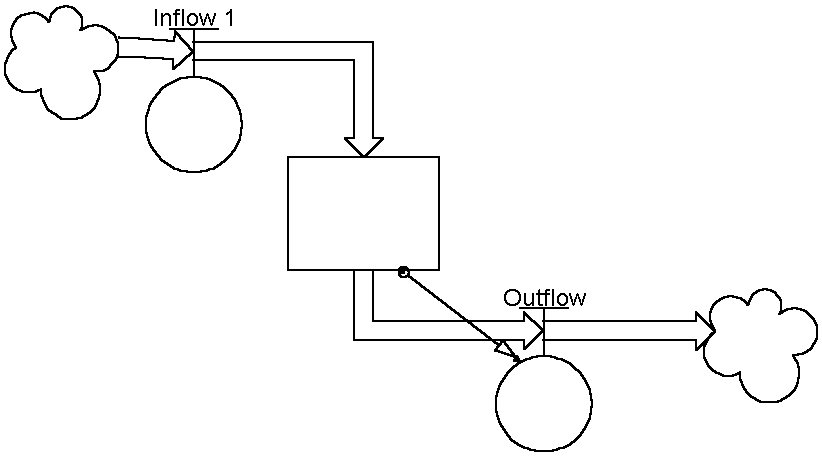
The line from Bath to Outflow indicates some relationship between thelevel in the bath and the rate of outflow. A little thought suggests that rate of outflowmust be proportional to the head of water; the deeper the water, the faster the outflow.
Running the simple model produces the graph in the next column—youknew it would. Provided the inflow rate remains constant as the bath fills up there mustcome a point at which the outflow rate, increasing as the bath fills, equals the inflowrate. Thereafter, constant level.

We can do more complicated things. In the figures below, we arethinking about a bank account. The account starts off empty. Once a month for 12 months ina row, the account-holder receives salary in arrears. At the end of the year, income ends.

During the year, the account holder has two kinds of outgoings:—
fixed expenses—rent, electricity, etc.,
other expenses, represented by the curved arrow from account to outgoings.
Like the water in the bath, the account holder spends in proportion tothe money in the account
The graph below shows the money in the account over 18 months. Ofcourse, this would be simple to calculate in a spread sheet: STELLA™ produces theresults in a spreadsheet, too.

Systems thinking comes into its own when things get a bit morecomplicated.
Imagine a typical "resistance to change" situation—thesort with which we are all familiar. You could represent it as two circles. The left hand,or virtuous, circle represents the drive towards a goal which feeds on its own success.The right hand, or vicious, circle show how the drive for change creates a resistance tochange within an organization which counteracts the Drive towards the Goal. You may agreethat this CLM is difficult to interpret; for instance, which loop will dominate, how longwill things take to settle, is there any point of stability…?
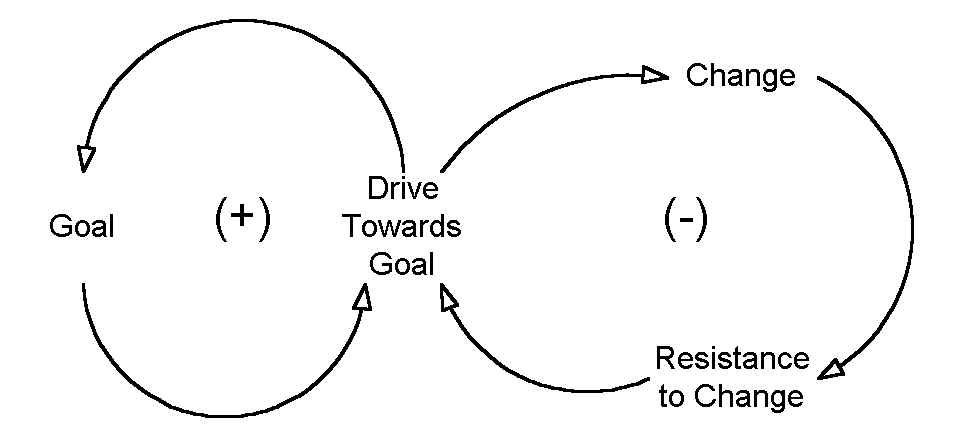
Below, you can see one way in which this virtuous/vicious circle mightbe represented in STELLA™.
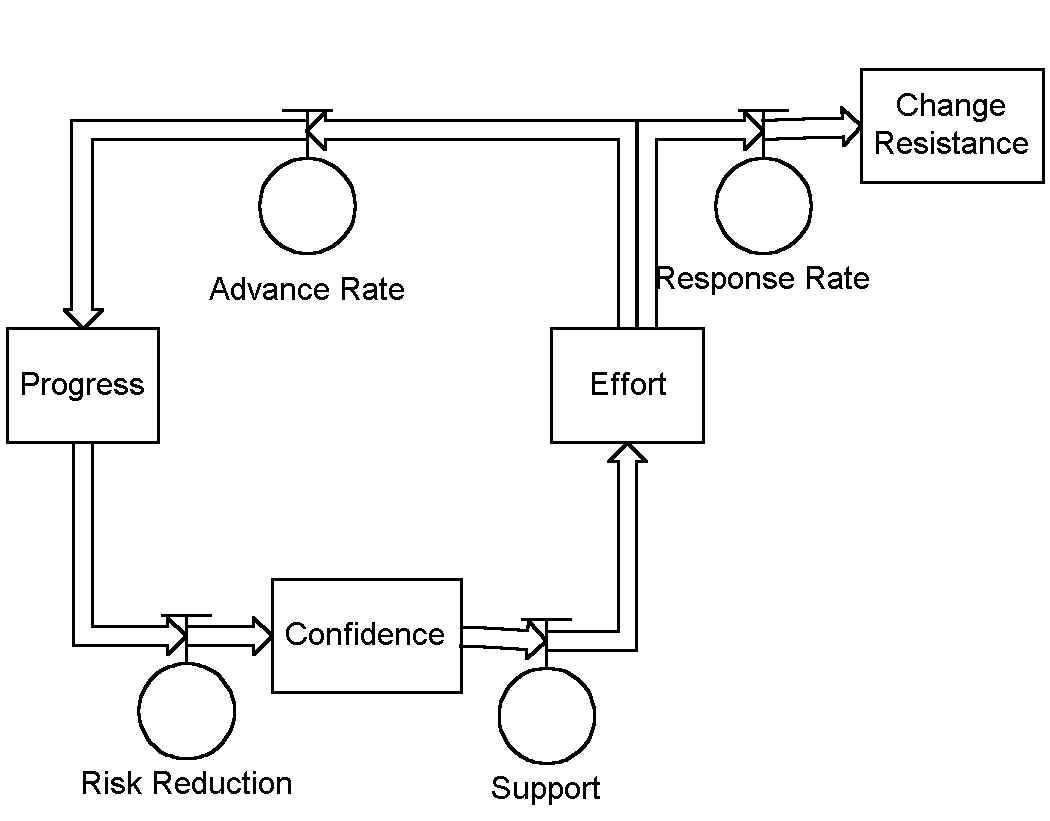
Extra features and ideas have been introduced to give some form to themodel.
For instance, the model assumes that there is some Maximum Resistanceto change, and that the difference between this maximum and the Change Resistance level,the Resistance Gap, will be driven towards zero as Change Resistance builds up. ChangeResistance, in its turn, is linked to Advance Rate; the greater the change resistance, thesmaller the Advance Rate. And the intended result, Progress, is represented as a levelimplying that it is progress against some target which expected so much Progress on aweek-by-week basis.
The resulting graph of Progress, shown below, on a week-by-week basisover 50 weeks shows the sorry tale. Everything starts off all right, but Resistance toChange kicks in at about Week 12 and the result is a progressive neutering of the project.By Week 50 there is virtually no Progress at all.

To reach such a conclusion, several assumptions had to be made: thestructure of the model, values for change resistance, and so on. The credibility of theresults is no greater than that of the assumptions. It would be better to assume that onlythe general form of the results were meaningful, rather than the actual figures. We arestill thinking, but with more rigour than simply using the CLM.
Nonetheless, we are making progress. If we can predict that the projectis doomed to failure over time, might we also consider how to prevent that outcome? Couldwe, for instance, add something to the virtuous/vicious circle CLM that might reduce theresistance to change? A training programme? An internal marketing exercise? Participativeplanning of the new project?
Armed with our new weapons, the CLM and STELLA™, we might now rushoff and think about the world at large. Fine, but…it might be more useful to thinkabout systems engineering.
Could we represent systems engineering as a process model with various feedbacks?
Should we consider such a model in isolation, or should it exist within a wider model of the whole company?
How complex should it be?
Should it include competitors?
What might we learn from such a model?
Could we model a lean production/assembly line?
How would it differ from mass production?
What might we learn?
Perhaps we can move on to these rather more momentous ideas next time.In the meantime, good thinking.
Derek Hitchins
REMINDER!! REMINDER!! REMINDER!! REMINDER!!
The Fourth Annual Symposium of the UK Chapter will now be held between1st-3rd June 1998 at the RAF Museum, Hendon. The subject will be:
Systems Engineering - A Matter of Choice
A full programme of events is planned, including papers from the UK,mainland Europe, USA and Australia, Case Studies, SE-PM papers, parallel sessions on thesecond day and a wide range of tutorial subjects to choose from on the third day. Theafter dinner speaker will be Lt. General E F G Burton OBE MA, Deputy Chief of DefenceStaff (Systems) and the dinner will be held on the evening of the 1st June, in the Battleof Britain Hall at the Museum. Discounted rates have been obtained for bookings made bydelegates at four nearby hotels.
Full details and the registration documents will be sent to all membersin the second week of March.
You cannot afford to miss this event, in fact, we have given you nochoice in the matter, it’s too good to miss!!
Joint meeting with IEE and the Royal Signals Institute at ImphalBarracks, Fulford Road, York.
2 Signal Regiment Headquarters Building
Tuesday 7 April 6:00 pm for 6:30 pm start
One of the most powerful management skills of the modern business worldis systems engineering. It is however possible to show that such techniques can bedemonstrated by reference to the management of complex historical events.
The entertainment industry has successfully used the masterclass toprovide a more enjoyable means of demonstrating their professional skills. ProfessionalGroup M5 has adopted this approach to provide a similarly entertaining method ofdemonstrating the strengths of systems engineering. This type of event is renowned forstimulating considerable audience participation and we are pleased to welcome two expertsin this field one of whom has considerable knowledge of Egyptology and the building of thegreat pyramids.
This innovative lecture will provide a fascinating opportunity to delveinto the mysteries of ancient Egypt while at the same time examining the modern usage ofsystems engineering.
The meeting will be followed by an optional formal curry supper in theOfficers Mess. Menu: beef/lamb/chicken/veg curry, profiteroles & chocolate sauce,coffee, wine on tables. Cost: £14 per head (cheques payable to IEE SEM Section please).
Booking is essential for this event, and attendees are asked to sendthe form below to W G Black, 12 Moorland Grove, Moortown, Leeds, LS17 6HS. There are notickets for this event.
-----------------------------------------------------------------------------------------------------------------------------------------------------------------------------------
I will be attending the IEE/RSI meeting at Imphal Barracks on 7 April1998 (*delete/complete as appropriate)
Name………………………………………………………ContactTel Number…………………………..
*I will be attending the formal supper in the Officers Mess. A chequefor £14 is enclosed
I will be travelling by car*/public transport*/other*.
Make of vehicle* (if travelling bycar)………….………………RegistrationNo*…………………………….
Names ofpassengers*……………………….……………………………………………………………….
………………………………………..……………………………………………………………………..
INTERNATIONAL COUNCIL ON SYSTEMS ENGINEERING: UK CHAPTER
In the vital run up to the UK Chapter hosting the InternationalConference at Brighton in June 1999, and in order to secure the growth of membership andinfluence expected over the next few years, the UK Chapter of INCOSE wishes to appoint anExecutive Director to take charge of day to day activities.
1. Scope of Work and Responsibilities
Reporting to the UK Board, the appointee would be primarily responsiblefor implementing the strategic objectives set by the Board. The position will also carryaccountability for the general administration and treasury functions of the Chapter whichare presently carried out by a combination of paid and voluntary assistance. Key dutieswill include the following:
· Stimulating the development of Education & Training courses for Systems Engineering, in conjunction with active members already working in this area,
· Planning, developing and directing annual symposia and other events, including regional activity, aimed at expanding membership numbers and the quality of service provided to members,
· Liaising and developing fruitful relations with other organisations having interests related to Systems Engineering,
· Keeping the Board, major corporate interests and the general membership informed and involved with an expanding base of Chapter activity and influence,
· Developing and implementing an effective marketing strategy for the Chapter and for the subject of Systems Engineering,
· Furthering the interests of members and the promotion of Systems Engineering as a discipline vital to successful business activity,
· Motivating the membership to take an active part in all the above and associated activities,
· Developing appropriate means by which the Chapter’s expanding activities are funded.
2. Attributes required
It is expected that the person appointed will have both a strong andinformed interest in Systems Engineering as well as a broad knowledge of businessactivity. The person must be able to work easily with people from a wide variety ofoccupations, at all levels of seniority and across different business sectors. The personshould be an able negotiator, pursuing the Chapter’s goals in strategic alliances andother formal and informal relations with other organisations. Relations and jointactivities with other Chapters abroad will also require both an international outlook andoccasional travelling. Indeed, Systems Engineering is destined for world class standingand the ability to appreciate and develop the necessary strategic vision at all requisitelevels is a key requirement, as is the desire to make a significant personal contributionto this process.
3. Remuneration
A retainer of £20,000 per annum with a budget of £5,000 for expensesnecessarily incurred will be payable. Secretarial services will also be provided, althoughthis may be done at a distance, in which case, the appointee will also have to be alreadyequipped and skilled in the use of the necessary communication and other facilities. Aminimum time commitment of 100 working days per annum will be expected, althoughcandidates for the position will be assessed in large measure on their willingness to makea substantial contribution, regardless.
Applications for and expressions of interest in the position should be directed in thefirst instance to the Chapter President,
|
Allen Fairbairn, 3 Trinity Road, Folkestone, Kent CT20 2RQ, |
Phone 01303 255255 (day) or 01303 850255 (evenings/weekends) |
An appointment will be made as soon as possible following review andprobable interview of candidates with representatives from the major sponsoringorganisations. An early take up of the position is strongly preferred, as the build up toBrighton99 has already begun!
Please send any contributions to this Newsletter to The Editor, INCOSEUK Newsletter, c/o Peter Lister, Aerosystems International Ltd., West Hendford, Yeovil,BA20 2AL.
Tel: 01935 443000 Fax: 01935 443111 e-mail:












Last Updated: 04 Apr 1998