
It has become a bit of a tradition to insert questionnaireswith the Newsletter. For this Issue we have set a new record withtwo questionnaires. It would have been three but I took pity onthe readership and the AeI photocopier and have left the thirdone as an open question within this editorial.
The first questionnaire is seeking data on a subject whichshould be very dear to the hearts of all professional engineers -education and training. A Special Interest Group (SIG) was formedat the Luton Conference and one of its first activities is to askthe membership for input. Ken Hambleton expands on thequestionnaire and the objectives of the SIG elsewhere in theNewsletter. I would encourage you to read his article carefullyand fill in the questionnaire.
The second questionnaire is seeking information on what ESIcould do for Systems Engineering. The questionnaire was preparedby the European Software Institute (ESI) of Bilbao Spain. Theiraim is to embrace Systems engineering within their activities onthe basis that Software Engineering and Systems Engineering areclosely related. I am not sure whether all Systems Engineerswould agree with this assertion, but nevertheless we should agreewith the principle that Software Engineering and SystemsEngineering are disciplines which have a high degree ofinteraction when considering systems with a high softwarecontent. I am sure that the INCOSE membership has much to offerin terms of useful information. All completed questionnaires willbe gratefully received by ESI.
The third (non-)questionnaire is related to the AGM event.Numbers were down on previous years from a relatively low base.The structure of the event has evolved based on the premise thatpeople may not feel like turning out solely for an AGM. The AGMthus forms a small part of the overall proceedings with theemphasis being on the presentation of topics of interest with theopportunity for interactive discussion. The open question which Iwould like you to consider is are we are offering the rightevent? I would be interested to hear any suggestions you have onmaking the event more popular as well as any reasons why you went(or didn’t).
Of course you are welcome to provide feedback on any subjectdealt with in this Newsletter (including the Newsletter itself),relating to Systems Engineering in general, or relating to theactivities of the UK Chapter of INCOSE. I know that all theofficers of both the INCOSE UK Chapter and main INCOSE arecommitted to meeting the needs of the members because without themembers there is no INCOSE. Operating the Newsletter in Transmitmode I never know whether the lack of receive data is indicativeof contentment or indifference. So make my day - send me ane-mail, fax or letter.
I cannot offer a brown envelope full of tenners to encourageyour questions or your answers. What I can offer is thatresponding to questionnaires or airing your views will helpfurther the cause of Systems Engineering and provide INCOSEmembers with better services.
Pete Lister
The UK Chapter AGM was held at the Tewkesbury Park Hotel onthe 27/28 October. As in previous years a minimalist AGM waspreceded by a seminar event to make things more interesting. Thevenue was more up market than in previous years and this seemedto go down well with those who attended.
The number of attendees was down from previous years at around45 people for each day. It may be that this had something to dowith the Noordvijk symposium which followed in short order (seereport elsewhere in the Newsletter). To avoid ‘death byquestionnaire’ I decided not to formally poll themembership, but if you have any views on the AGM - whether or notyou attended the event - please feel free to contact theNewsletter editor.
There were several subjects for presentation and discussionranging from The Way Ahead for INCOSE, through Education andTraining, and Working With Other Disciplines, to some feedbackfrom the Foresight report. As usual with these things you reallyhad to be there to get the full flavour, but here are a fewhighlights that I noted:
Bill Bardo, the soon to be Past President, made it clear thatGEC were fully behind INCOSE at a corporate level and wereencouraging their staff to join. GEC will now pay for INCOSEmembership. This is an encouraging endorsement of the value ofINCOSE to the Systems Engineering community.
Peter Brook, speaking in his capacity as the Director ofRegion VI, reminded us that much of the INCOSE information isavailable on the Web. He also announced that the money to enablethe INCOSE Journal to be published quarterly has been approved bythe main board of INCOSE. The first issue is on its way and itwill be published free to all members. INCOSE as a whole hasaround 2800 members, but the turnover is high (the highestmembership number is 5000+). This mirrors the UK experience. Healso announced that both Holland and Germany have formallyregistered as Chapters and that France is close. A secondRegional Director will be assigned, underlining the importance ofEurope to future growth of INCOSE.
John Boardman reported on the Education and Training SIG whichwas kicked off at the Luton Conference. He suggested that it wasnecessary to consider vacation courses, distance learning, NVQsand education of the bosses whose signatures are required on theform! He spoke of an EPSRC call for networks to share SystemsEngineering knowledge. He hoped that the first £50k fundingwould be released soon to start activities in this area. Onething would be to collate and maintain a register of shortcourses.
Bill Bardo, in reviewing the past year, noted the emphasisplaced on the Foresight activities. The Foresight Report wasbeginning to raise awareness of SE and gain influence withgovernment, funding bodies and universities.
The UK Chapter has been active in Europe, attempting todevelop a regional identity. At the same time attention has beenpaid to enhancing services to individual members in terms ofproducts, working groups and regional meetings. He was consciousof the need to address the needs of current and potential membersNorth of the border.
Harry Hughes of I-Logix had reported on the previous day thathe was going to take a new look at INCOSE as business and try tofind new ways to spread the word and encourage new members. Hesuggested that this might be a better way to proceed than theMembership and Communications Committee which has not met forsome time. He asked for any INCOSE UK members who were interestedin helping or who had any ideas to offer to contact him().
Much of the day to day work of the Secretary has now devolvedto John Mead, but there is still the issue of achievingcharitable status for INCOSE which has to be addressed.
John Sole reported on the current financial state of theChapter. The accounts presented were not the formal auditedaccounts which are due to be presented to the Board shortly. Thefunding argument with INCOSE central has now been sorted out, butthe final settlement has created some abnormal entries on theaccounts. We should now receive a steady stream of contributionsfrom central.
If anyone wants to see a copy of the audited accounts theyshould ask the Treasurer. The bottom line is that the Chapter issolvent and maintaining enough funds to underwrite our majorevents such as the annual Conference.
Mike Prince reported on the SEPDC activities for the pastyear. These included:
The committee has a pool of 12 members of which there is adedicated core of 6 who turn up to most meetings. These includePaul Newman who is the secretary and John Mead who provides avaluable communications link with the Main Board. Five meetingshave been held this year.
Future activities include planning next year’s UKsymposium, further development of the UK Web site, increasing UKregional meeting structure to take on interest group activities.
As usual there was no great rush of volunteers for the UKChapter Officers. As a result the Board proposed a list of names,which included those who were already in ‘elect’positions. It was proposed that the officers should remain inplace for 2 years to ensure continuity through the 99 Symposium.This will be confirmed at the next AGM, when hopefully the‘elect’ positions for the following year(’99/’00) will also be filled. The proposal was agreedby the members at the meeting, and hence the followingappointments have been made:
| President | Allen Fairbairn | |
| Treasurer | Alan Mansfield | |
| Secretary | Bob Gates | |
| Industry Chair | Ian MacFarlane | |
| Academic Chair | John Boardman | |
| IEE Representative | Paul Budgen | |
| SEPDC Chair | Mike Prince | |
| Membership & Communications Committee Chair | Harry Hughes | |
| Immediate Past President | Bill Bardo |
Our thanks must go to those who have stood down for all thework that they have done to help the development of the UKChapter.
43 papers over two and a half days attended by over 300delegates made the 1st joint ESA/INCOSE Conference on SystemsEngineering a major event. There was plenty of UK representationand an impressive array of senior INCOSE members from the US. Themost important thing was that the ESA connection seemed to haveencouraged a huge representation from Europe. Not surprisinglythere was a large contingent from the Netherlands - including alarge proportion of the Netherlands Chapter - but there were alsodelegates from Germany, France, Belgium, Italy, Austria, Swedenand Finland.
As well as a wide variety of nationalities there was a widevariety of industries represented. Apart from the space sectorthere were representatives from automotive, tunnelling, transportinfrastructure, as well as the omni-present military andaerosystems sectors. It was interesting to see that the existingSE Process Standards - notably MIL-STD-499A and IEEE 1220 - hadbeen applied successfully to other industries where large‘one-off’ projects were typical. In contrast those fromvolume production oriented sectors were more interested inConcurrent Engineering and Product Engineering which approachSystems Engineering in a somewhat different way.
Eric Honour, the INCOSE President, gave an inaugural addressin which he reminded us that systems are built by people. Around2,800 of these people are INCOSE members. He announced thatGEC-Marconi have become the first non-US company to join theCorporate Advisory Board. He also warned us to beware of thealmost religious basis for some of the Systems Engineering‘truths’. We must be more scientific in assessing ourmethods and approaches for Systems Engineering.
There was a strong flavour throughout the conference on SEprocess and process improvement. There were certainlyconsiderations of the need to reduce the cost and timescales ofSE and Product Development as well as satisfying the technicalneeds of the customer. It is this which has focused ESA’sthoughts onto improving its own SE Process.
The tool vendors were also on hand to demonstrate their latestwares. As well as the familiar names there were stands from someof the consultancy organisations which seem to be in the vanguardof bringing SE into a wide range of industries in Europe. Not afew of the consultants became available after the collapse ofFokker Aircraft. They were most interested to hear what the afterdinner speaker had to say at the conference dinner. He was theperson responsible for running Fokker whilst trying to findbuyers for the business.
The ESTEC conference centre proved a practical and interestinglocation for the symposium once you got the hang of thearchitecture. Curved walls of concrete, wood and glass and analmost total lack of symmetry made an elegant environment, andthe adjacent restaurant sustained the inner man/woman with a widechoice of lunchtime refreshment.
The Cocktail Party at the end of the first day was held in theSpace Expo - a museum/exhibition of space exploration. Thisprovided an interesting location to sip a restorative and talkwith other delegates.
There were busses to transport delegates to and from theNoordwijk hotels which all overlooked the dunes, the beach and arather cold looking North Sea. Overall the organisation was firstrate. The low corporate rates for the excellent hotels and thefree conference attendance contributed to make the eventenormously good value for money. The proximity to Schipholairport with its international connections made it easy to reachfor all delegates. So the message is, if there’s anotherconference at ESTEC, make sure you arrange to go.
Pete Lister
As many members will know, one of the Chapter members, StuartArnold of DERA, is joint author for the ISO standard on SystemsEngineering. He has told us about its origins and its progress ata number of INCOSE events in the past and we are, of course,privileged to have this up to date information on what shouldbecome the standard for System Engineering.
It has been discussed in the past, how we might assist Stuartto gain members' views on the Standard and time allowed forcomments and questions following past presentations has been thenormal method of doing this. However, this is not very effective.We all have our own pet views of System Engineering and Stuart'stask is difficult enough as it is without asking him, in effect,to reconcile what are often little more than our top of the headreactions to what has become a very complex subject. I, for one,have not followed what Stuart says is being done - it is notintended to be prescriptive, he says, but it seems like it to me,at least implicitly, in the limited glimpses I've had of it inhis recent presentations. I take this to be a reflection of thedifficulty in grappling with these issues in a limited time slot.Having discussed with Stuart how we might help him with morepositive views and constructive suggestions, as was firstintended, we have agreed that a specific meeting could be held.All those who have a real interest in the Standard and areprepared to put some real effort into it would be welcome toattend.
The general format would be that Stuart would present thestatus so far reached and summarise the key remaining issuesbefore engaging in an open discussion which might lead to furtheractions. The status of the meeting would not be formal in anysense, as there are formalised (and, probably, ineffective) waysfor individuals and organisations to comment on ISO Standardsthrough the BSI. However, the meeting could produce some usefulpoints and help Stuart gain a clearer view of what the feelingis, "out there".
The proposal is to have a one day meeting at DERA inFarnborough, at 10.30hrs on 14th January 1998 at DERA Farnboroughat the Codi Building. Up to 20 people can be accommodated, lunchwill be provided. Discussions can continue into the afternoon ifappropriate. The meeting is scheduled to occur immediately priorto an ISO 15288 committee meeting which Stuart will be attendinglater that month. Please register your interest with Stuart inthe first instance (Fax him on 01438 756293).
Last time we nattered about the general ideas of systemthinking - what it is, why we need it and so on. This time, Ithought a real-world examples might help. Nothing to do withwork, you understand.
Let me start the following example by saying that we are nottalking about right and wrong. What follows is simply a view onthe subject of school truancy and what might be done about it. Byexpressing views openly in this way, you can see what they are,and can choose to agree, or disagree. At least there is less roomfor misunderstanding - or, what is often worse, believing thatyou agree when you do not.
I tend to start with a so-called Laundry List of possiblecauses, as in the figure below.
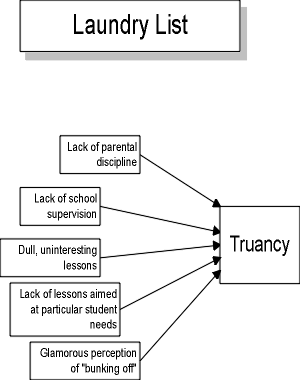
Laundry Lists are seductively simple. They exploit the humanpropensity for criticism - we are all excellent at sayingwhat’s wrong with just about anything. You can turn thattendency to advantage!
Just think about it. If you asked someone what was good abouttheir world, and then asked them what was bad about their world,would you get a longer list from the good points, or from the badpoints?
Looking at the Laundry List, you can see that the variousfactors are not all independent; some, at least, are related.
By dropping the pejorative (i.e. all the negative descriptorslike "lack of…") it is possible to put all thefactors together into a Causal Loop Model, (below). As last time,open headed arrows mean "A causes, or changes in sympathywith, B", while solid-headed arrows mean "A changes inthe opposite sense to B".
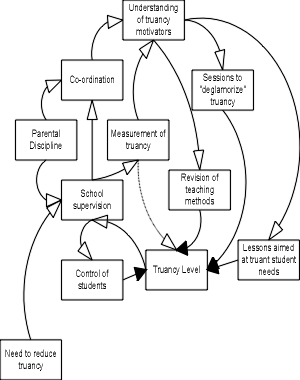
To see how it has been formed, look at Truancy Level and startto work anti-clockwise. "Lessons aimed at truant studentneeds" was clearly derived from the Laundry List item"Lack of lessons aimed at particular students’needs". The pejorative term, "lack of…" hasbeen dropped.
To establish what truant students need in the first instance,it would be necessary to understand their motivation - see theCLM. As you work backwards around the loop, you will see that theother factors fall logically into place.
Some new factors have been introduced too - that is one of thestrengths of CLMs. In order to close each loop, there must be acorresponding closure of ideas. This closure is important - itsignals the completeness of some kind of system, generally foreither positive, or negative, feedback. No closure - no system.
Note also the introduction of new ideas. As the loop wasdeveloped, the notion emerged that it would be necessary to knowthe extent of truancy - some means of measuring was needed, bothto know the extent of the problem, and to detect any changeswhich might result from trying to reduce the problem.
Given the need for measurement, then school supervision comesto the fore - who better to be aware of truancy that theteachers. Note that, as the truancy level rises, the need forschool supervision rises in sympathy. Note, too, that asmeasurement of truancy rises, so does truancy itself.
Why would that be so? Two reasons. First, with measurement,the true scale of truancy is likely to be revealed, and is likelyto exceed expectations. Second, the bravado nature of sometruants may induce them to "bunk off" rather more oncethey are aware that they are under the spotlight.
Finally, note the positive feedback loop School Supervision -Co-ordination - Parental Discipline - School Supervision. Thissuggests that parents (need to) support teachers and thatteachers support parents.
So, in this example, what has systems thinking achieved? Ithas addressed a complex problem and expressed an approach toresolving that problem. One view of the CLM is that it presentssome sort of "Ideal World". Given such an Ideal World,it is possible to compare it with the real world and use thedifferences as a driver for change.
This technique is embedded in the General ProblemSolving Paradigm, shown below.
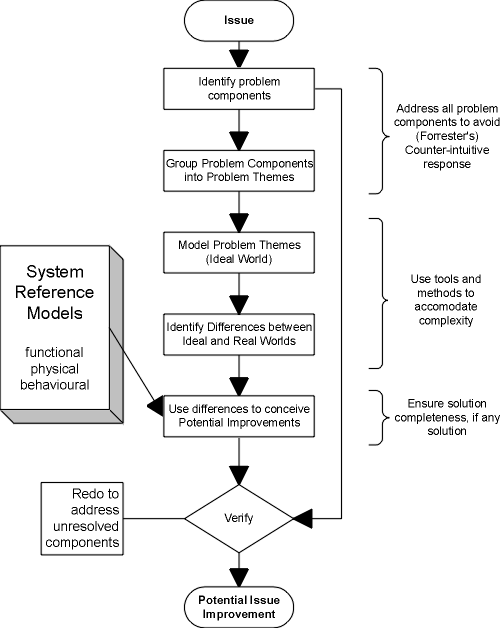
Our truancy example has been following the GPSP as follows:-
| Issue | Truancy |
| Identify Problem Components | Laundry List of Possible Causes |
| Group Problem Components into Themes | (Not done -example too simple) |
| Model Problem Themes (Ideal World) | Causal Loop Model |
Enough already. By now you are either reading another article,asleep or raring to try this new-found skill on a complex problemof your own. Try something simple first! Please!
Next time, we will look at limitations of Causal Loop Models,and what we can do to "think systems" more rigorously.
I’ll be back
Derek Hitchins
At the AGM in Tewkesbury last month, I agreed to try tobreathe some life into an INCOSE initiative on SystemsEngineering Education and raining, or SEET for the acronymaddicts. I need the help of all interested members if this is tosucceed. Otherwise I shall recommend that we adopt an alternativename such as INcose Education, Research and raining so that ourproposed SEET of learning becomes INERT.
In planning a course of action, my starting point was theForesight working Party report on "Building IntegratedSystems" published in July 997 by the IEE in conjunctionwith INCOSE and the Royal Aeronautical Society. Therecommendations concerning Training and Education included thefollowing as important issues to pursue -
My views on these recommendations together with my ideas forthe initial actions needed to carry them forward follow thisintroduction. I propose to continue by gathering data from INCOSEmembers and you will find with this copy of your Newsletter abrief questionnaire which addresses these and other issues.
Some engineering departments already include elements ofSystems Engineering in their undergraduate syllabi and, whilstthis is to be welcomed, the approach is rather ad hoc andindividualistic. I have no firm views on how a consensus mightbest be reached on the length and content that should be taughtat undergraduate level, or indeed whether a common syllabus isdesirable, and I would welcome any thoughts from INCOSE members,particularly academics, on this issue. Perhaps we should start adiscussion group on the Internet. The debate could include howbest to persuade busy departments with full undergraduatetimetables to include a short burst on Systems Engineering.
At post graduate level there are several MSc courses availablebut again the picture is very fragmented. The courses have beenimplemented by individual departments either to fulfil specificneeds or by academics dedicated to certain aspects of SystemsEngineering. An example is my own MSc at UCL on Defence SystemsEngineering which has been taught for the past 6 years, largelyto students from the MoD. In common with other Masters Courses,it is now available in modular format so that specific elementscan be incorporated into other MSc courses or it can be studiedover several years on a part time basis.
This seems to me to offer a way ahead for the teaching ofsystem principles to common standards with agreed definitions andsemantics. If, within the UK Chapter of INCOSE, we can generateappropriate modules of, say, a week’s duration, there is anexcellent opportunity for these to be imported into post graduatecourses, particularly when either the lecturers or the employersof the student population are INCOSE members.
We need three main ingredients for this recipe. First, abetter idea of what the customers believe they need, second, aknowledge of our potential coverage and, third, a set ofappropriate modules to offer to course organisers.
On this task, I would like to hear from a few expert systemspractitioners willing to help generate appropriate modules. Ialready have some people in mind but would prefer it if they camewillingly to the party. How we proceed in detail will depend onthe answers to the questionnaire and the views of the experts.
These will essentially be short courses or seminars of from aday to a week in duration and I see a need for two distinct typesof event.
Firstly, general education and training courses to promulgatebasic systems engineering principles and best practices toindustrial engineers and managers at all levels. These will needto be advertised strongly in order to attract suitable audiences.
Secondly, bespoke courses on specific topics in response torequests from sectors of industry or from groups of INCOSEmembers who will therefore provide a ready audience of willingparticipants.
I propose that these courses would operate on a full paymentbasis and would be organised to break even financially usingrealistic values for student numbers and course costs, includinglecturers’ fees. They could be held at university venues orindustrial sites depending on audience preference, withprestigious courses for senior managers organised in conferencehotels. Joint sponsorship with the professional Institutions maybe advantageous for some courses and seminars.
I plan to keep a register of lecturers who would be willing toassist in preparing and presenting these short courses, togetherwith their particular expertise. I already have contact with arange of appropriate lecturers from a variety of universities,companies and government departments but would welcome theinterest and involvement of others. Please respond on myubiquitous questionnaire.
I am interested in pursuing recognition and accreditation forsystems engineers but unsure at present how best to proceed.Perhaps we should debate this in the INCOSE web pages on theInternet as there are several important issues to be addressedwhich include -
Note that post graduate educational courses are not currentlyaccredited by the major engineering institutions, although Iunderstand that certain training courses are.
I leave you with these questions and welcome your thoughts.
Data Input via Questionnaire
I hope that you will all take a few minutes to fill as manyparts of the questionnaire as you can - we cannot workeffectively without your data input. However, I suspect that whatsounds like a straightforward, objective activity will inevitablyresult in an incomplete, subjective database. Some courses withthe words "Systems Engineering" in their title may notbe what INCOSE members regard as Systems Engineering and othercourses which do not use these words in the title may have a highcontent of appropriate material. I am therefore particularlyinterested in those postgraduate courses on which members cancomment favourably from personal knowledge and experience and Isuggest that these should form the initial targets for ouractivities.
In closing, I stress that I can only succeed in helping you asINCOSE members if you are willing to help me in return. Yourfirst easy action is -
COMPLETE THE ENCLOSED QUESTIONNAIRE.
Ken Hambleton, Professor of Defence Engineering, UCL
The European Software Institute are becoming interested inSystems Engineering, and are seeking reponses to a questionairre.The hardcopy newsletter included a hardcopy questionnaire.
Get your diaries out to plan your attendance at theforthcoming events discussed below and listed on the EventsCalendar.
The theme for our 1998 UK Symposium is "choice": forexample how systems engineering provides processes both forgenerating a spectrum of solutions for a given set ofrequirements and for selecting the most appropriate in theprevailing circumstances. The capacity to generate and deal withchoice is one of the characteristics of systems engineering thatcommend its application both more widely in the engineeringsector and in any other field of human activity where the aim isto provide better solutions.
Personal recommendation based on practical experience is themost effective form of advertising. The symposium gives you theopportunity to share your experience and observations with othersystems engineers and with those who are considering the benefitsof adopting systems engineering.
Think about your experience of systems engineering and whatyou have learnt that could usefully be shared with others. Thenput a few choice words together to outline the paper you areprepared to offer for the symposium and mail, fax, or email themto John Mead or Mike Prince.
The AGM at Tewkesbury was briefed on what had been done so farto prepare for the UK Chapter to host the 1999 INCOSEInternational Symposium in Brighton from June 6-10 1999. My lastslide had one word on it- HELP!!
In addition to those who I had already approached, a number ofothers present volunteered and in the afternoon, the launchmeeting was held of the 1999 Symposium Committee.
The positive reaction from the AGM and the enthusiasm of the'volunteers' is very welcome and gives me confidence for thefuture. The timely success of the Noordwijk Conference hasgreatly contributed to the credibility of INCOSE in the UK and inEurope.
Returning to the headline of this item, perhaps I should saythat, whilst a higher gear has been engaged, I don't yet feelI've really removed my foot from the clutch! However, by the timethis newsletter is published, I hope we will be moving alongproperly with the aim of preparing our input for the INCOSEWinter Business Meeting in Dallas.
Peter Robson
Prof Derek Hitchins and Paul Budgen present a Guest EveningMasterclass Talk at the School of Equipment Support (A),Arborfield near Reading on Thursday 4 December 1997. This lectureprovides a fascinating opportunity to delve into the mysteries ofancient Egypt whilst at the same time examining the modern usageof systems engineering.
The meeting is co-sponsored by the IEE and INCOSE. There is nocharge for the lecture, but a charge of £10.50 for a buffetmeal. Places have to be booked in advance as soon as possible butcertainly before Thursday 27 November. Please contact DouglasMarlow, 27 Buttenshaw Close, Arborfield. Reading, RG2 9LX (Tel0118 9760786 (H) or 0118 9763469 (W)) for details.
Regional events are being planned at York and Yeovil in thefirst quarter of next year. The subjects for these two meetingsat two of the furthest outposts of UK INCOSE have yet to bedetailed. Hopefully details will emerge before the nextNewsletter.
If anyone in the South West has any suggestions of suitabletopics for the Yeovil event I would be very pleased to hear fromyou. If any one is keen on setting up a regional event (see Issue9 of the Newsletter) please contact John Mead, who will be verypleased to hear from you.
Pete Lister
Reduced Terms for INCOSE Members and an opportunity for freeattendance for one member!
The UK Chapter is sponsoring another event organised byEuroforum. It is a two-day Conference to be held at the WaldorfMeridien Hotel on January 19th and 20th, 1998. The Conference,entitled "Cross-Platform Interoperability & NetworkManagement".
Euroforum, who are incorrigbly commercial, have said that theterm "Systems Engineering" was not sufficiently wellrecognised in the Telecommunications Industry to be included inthe main conference title! Consequently, it was relegated to thesubtitle: "Optimising Projects and Partnerships usingSystems Engineering Techniques." which shows, nevertheless,the centrality of the discipline to the theme of the Conference.
There is a discount of £100 for INCOSE members, which makesit well worth while for non or lapsed members to join/rejoin, ifyou're planning to attend.
There is also a free ticket, yes, A FREE TICKET for a verygood seat for the whole of the two days for anyone who isrelatively au fait with the telecomms industry, is fairly seniorin his/her chosen area and who doesn't mind a bit of limelight.Please contact Allen Fairbairn for more details of this hard torepeat, genuine offer! (phone: 01303 255255, fax: 01303 250252,e-mail: ).
Allen Fairbairn
I have been a little remiss in publishing contact details forINCOSE UK officers. This is by no means a full list but itincludes all of those mentioned in this Newsletter.
President:
Allen FairbairnChair of SEPDC:
Mike PrinceChair of INCOSE ’99 Committee:
Peter RobsonChair of Communication and Membership Committee:
Harry HughesUK Chapter Webmaster
Steve MallonUK Chapter Administrator:
John MeadUK Newsletter Editor:
Pete ListerMake my Day - Fill This Space!!
It is a constant juggling act trying to fill the space in theNewsletter and make the best use of the pages available. As youcan see there is more than a little space left over for thisissue.
This could be filled with your contribution, a letter, a shortarticle, an event listing or even a paid advertisement. Thenewsletter is intended to provide a platform for all INCOSE UKmembers to communicate their ideas and the Editor is always readyto receive new material.
|
Dates for your diary: Forthcoming INCOSE Events |
||||
|
Date |
Event |
Main Topic |
Venue |
Status |
|
28 Nov ‘97 |
Board Meeting | Programme for next year | BAe Farnborough |
Confirmed |
|
2 Dec ‘97 |
SEPDC Meeting | European wash-up | SPS Christchurch |
Confirmed |
|
4 Dec ‘97 |
Regional meeting | S Engineering the Pyramids | Arborfield, with IEE (Reading Area.) |
Confirmed |
|
19/20 Jan ‘98 |
Euroforum | Cross Platform Interoperability | London |
Provisional |
|
2 Feb ‘98 |
Board Meeting | Winter Meeting | GEC Marconi Rochester |
Confirmed |
|
2 Feb ‘98 |
Regional Meeting | A National Strategy for Systems Engineers and Engineering | GEC Marconi Rochester. 19:00 |
Confirmed |
|
March |
Regional Meetings | TBD | York & Yeovil |
Provisional |
|
20 Apr ‘98 |
IEE Colloquium | The SE of Aerospace Projects | IEE London |
Confirmed |
|
18/19 May '98 |
4th UK symposium | SE - A Matter of choice. | A four star country hotel. |
Provisional |
|
Sep ‘98 |
RMCS/DERA | MoD | Shrivenham | |
|
Nov ‘98 |
INCOSE/ESI | SE & Software Engineering | TBA | |
The Newsletter is also a useful medium for a mail-shot toaround 300 Systems Engineers in the UK. The Editor is quite happy(well fairly happy!) to ‘stuff’ additional material inwith the Newsletter. INCOSE UK reserve the right to requestsupport with the postage to cover commercial material,particularly where this results in the package exceeding thebasic letter weight for standard postage charges.
Its up to you, if you have something to say then theNewsletter can provide a medium for you to say it. The nextNewsletter should hit the streets in mid February - so getwriting over the Christmas holiday season.
By the way, don’t forget the INCOSE web site athttp://www.incose.org.uk if you want a more direct method ofcommunication.
We look forward to your contributions.
Pete Lister
Please send any contributions to thisNewsletter to The Editor, INCOSE UK Newsletter, c/o Peter Lister,Aerosystems International Ltd., West Hendford, Yeovil, BA20 2AL.
Tel: 01935 443000 Fax: 01935 443111 e-mail:












Last Updated: 06 Oct 2002