
This issue of the Newsletter is packed with information onINCOSE events past and future. I hope that it will convince bothold and new members that INCOSE is the place for SystemsEngineering professionals to meet and discuss ideas. The Internetand e-mail are becoming the primary method for exchanging ideasand communicating with fellow members, but nothing can replacegood old fashioned human interaction at a Symposium or discussionmeeting.
I dont know about anybody else, but INCOSE is fastoutstripping the time I have available to spend at Symposia. Hoton the heels of the UK Symposium in June and the InternationalSymposium in August, we have the European forum in November. Ifthats not enough there is the AGM in October and the firstUK regional meetings to follow. There is a little time to catchones breath before the 4th UK Symposium in May 1998.
We then have a major challenge in the form of the 1999International Symposium to be held in Brighton. See the flyerincluded with this Newsletter for details of the venue. Read thereport from Stuart Cornes on the LA Symposium for a flavour ofthe work needed to launch this event.
By the way, if you have never been to an AGM you may not beaware that it is 95% systems engineering and only 5% bureaucracy.The emphasis is more on discussion rather than formally presentedpapers and it is a great way to catch up on and get involved insome of the initiatives that you have read about in these pages.See if you can join the faithful few this year atTewksbury Park Hotel, I am sure that you will find it interestingand enjoyable.
As you will see from elsewhere in this Newsletter, theForesight programme has begun to publish reports. This should beof interest to all involved in Systems Engineering. Look out forPeter Brooks article in the next issue of Insight (the mainINCOSE magazine).
All of this adds up to an exciting year ahead as we do ourbest to put Systems Engineering on the agenda. If you have anyideas for meetings, events or things that INCOSE should beinvolved in please let us know. Remember that INCOSE belongs toyou, its members, and you are encouraged to add your own petsubject to our agenda.
And Finally
After a slight dip in the membership, the UK Chaptermembership has recovered to around the 200 mark. If any of youknow anyone who would benefit from being a member of INCOSE howabout persuading them to join up? Those of you who have beenreceiving this Newsletter but are not currently members of INCOSEshould join up if you want to keep receiving it. From the nextissue the UK Newsletter will only be distributed to INCOSEmembers assigned to the UK Chapter.
Peter Lister
If you are asking yourself what could cause 125 otherwiseapparently sane people to go to Luton for 2 whole days in June,the answer is the Third Annual Symposium of the UK Chapter ofINCOSE. (Nominations for the venue for next years symposiuminclude the Black Hole of Calcutta, The Gobi Desert, and Luton).
After a welcome speech by Bill Bardo (the Incose UKPresident), Steve Robinson (Chairman of IEE Management and DesignDivision) gave an entertaining keynote speech in which heproposed replacing the Systems part of SystemsEngineering with Command and Control, on thegrounds that Systems to most people imply things thatare complex and liable to failure. He identified 3 keytechnologies which need boosting : (1) The combination of datafusion, vector processing and pattern recognition, (2)Requirements capture, and (3) Reconfigurability.
Unfortunately Rich Widmann was unable to make it to Luton, butAllen (Swampy) Fairbairn managed at short notice to fill theholes left in the venue in the area of the Capability Model,aided and abetted by Colin Tully. Colin gave a comprehensivedescription of the current status of the various capabilitymodels in existence today.
The first day was rounded off with a conference dinner andafter dinner entertainment courtesy of Barry Roberts,scriptwriter and cartoonist.
There were many interesting papers presented during the twoday symposium, details of which can be found in the proceedings,so there is little benefit in trying to summarise them here.However, the lasting memories of Luton which linger in my mindlong after the temporary deafness caused HGV lorries trundlingpast the hotel all night include:
When John Mead telephoned me at home early on the morning ofSunday, 1st June, I suspected it wasn't just to enquire after myhealth. Our main symposium speaker, he told me, had just faxedhim from the States to say that he was very grateful for ushaving organised his hotel when others had failed but,unfortunately, something had come up and he couldn't now comeover. So, what was I going to do about it? Having given not one,but two slots to a speaker with hands on experience of applyingCMM - a subject which everybody had said was the topic to include(but, to me, was little more than an acronym I had only recentlycracked) I didn't think we had an immediate answer to thisquestion.
As I drove up to Luton in the afternoon, it slowly dawned onme that I would have to step in somehow. I couldn't reasonablyask anybody else to step in at such short notice, so I set aboutreading the two papers early that evening and imagining how Icould plausibly present a worm's eye view of CMM when everyonewas expecting an eagle's (sic!). In the event, I needn't haveworried. Relief came in the form of Colin Tully, who not onlyknows a great deal about CMM, but was, also, willing to step intothe breech - not with 24 hours notice, as I had, but with ratherless!
I know that many people appreciated Colin's presentation andcommentary on Rich Widmann's papers and on the subject of CMMgenerally. There was some criticism, gathered from thequestionnaire returns, that perhaps we had invested too much inone speaker and/or we did not have any fall-back plans. Havingjust started to appreciate the role of Risk Management in aSystems Approach, I can agree, to some extent, but allow for 24hours notice of withdrawal? (Having now mentioned CMM and RiskManagement, I can ask members whether they are aware of a RiskManagement CMM. Yes, I was amazed as well, but our growing linkswith the APM reveal a SIG (Special Interest Group) of theirswhich deals with Risk Management and their first journalpublication includes a paper entitled "Towards a RiskMaturity Model" Anyone burning to know more, please contactme and I'll give you further details).
Back to the Conference and having handed most of itsorganisation over to others this year - John Mead and Mike Princein particular (both of whom did an excellent and generally unsungwork) - I had been looking forward to just sitting back andlistening to the papers. I had wanted to put some real effortinto trying to come up with a considered summing up session butevents were obviously conspiring against me. First, myself-imposed and ultimately unnecessary crash course on CMM.Then, we clearly had a lot of diversity in the papers (there wererumblings that a clear theme for the papers wasn't emerging;well, at least some people are, it seems, beginning to understandand use the concept of emergent properties!) The Keynote speakerhad started off actually by stressing his lack of qualificationsto speak on the subject! Even the perennial Robertum Sharpumseemed to be going to seed at the end with a very sensible pieceon Value Engineering. So much for trying to order a bit ofdisorder and controversy.
But I neednt have worried. The summing up to make andthe conclusions to draw became self-evident, as I often find withSystems matters. The diversity of papers was, in my view, agenuine reflection of SE in Practice. There are no simpleanswers; the subject is very broad and multi-faceted. Our keynotespeaker put it like this: "Systems implies a degree ofcomplexity which virtually guarantees an expectation offailure". I did not take that as a criticism of thediscipline of SE or its practitioners. Rather, it is adescriptive view of the difficult task we face every time we tryto engineer a system efficiently, effectively and consistently todeliver that which is expected of it. And our keynote speaker washardly far from the mark when he also identified the followingkey factors:
Now I could see elements of these factors being covered bysubsequent papers. For instance, there was a lot said about theSE-PM relationship and Andrew Farncombes paper showed us insome detail one way of effecting collaboration between these keydisciplines. The primary need for requirements capture wasstrongly reflected in at least three other papers.
But the clearest message of the Symposium came out via theground swell of interest in Education and Training. Arising outof an ad hoc session on the second day, it became very clear thatit was in Education rather than Training that the need for actionwas felt. I found this very encouraging. There is, I believe, abroad appreciation that people cannot simply be trained asSystems Engineers. A broad education and experience seem to beprerequisites and long term investment in this is the only way tomake real progress. Attempts at short term fixes, shallow viewsof our discipline, minimising its role in order to down rate itsimportance, trying to replace people with a process when creativethinking is required; these are all part of the intellectualdishonesty that is involved in much of the present misconceptionsheld about systems engineering.
In my conclusions, I suggested that in seeking to promoteSystems Engineering, we were up against years of neglect and,indeed, vested interest in a culture for project management andbusiness process which didnt really want to face up to thereal issues. Fudging complex issues and being seen to be doingthe right thing, rather than actually doing the right thing - andeven doing it right - are generally considered to be far moreimportant skills than working for a shared understanding ofsystems principles and learning how to deal collaboratively onproblems.
Going over my summing up notes, I see that I wrote at the end,"If, in your practice of Systems Engineering, you have founda means of avoiding having to deal with the more generic issuesand concepts such as coherence or completeness and all that isentailed, then wed like to know about it." Since Ihavent heard anything from anybody yet, either I thoughtbetter of ending on such a note at the time, or else nobody hasyet found the short term fix that makes "doing systems"easy, or if they have, theyre not letting on.
The original brief for the 3rd Symposium was to produce avalue for money event that would give members what they wanted inthe way of technical papers and information. (And by the way, donot spend too much on the hotel!). The Symposium would also beused as a means of attracting interest from SE practitioners andothers with a view to possible membership.
The questionnaire, whilst not being the only means ofidentifying whether these objectives were achieved, was designedto do this and to elicit the sort of information that the UKChapter Board requires in order to plan the next event. In termsof completed forms, we received just over 50% returns - which ishigh.
The symposium was successful in achieving a 30% increase onprevious numbers of attendees and made a useful contribution tothe Chapter funds needed to finance its continued operation.There was also a significant number of new members joining andold/lapsed members renewing.
The overriding conclusion from the questionnaire was that itwas a successful event. For whatever reason the questioneliciting the most favourable response was No 9 - The SymposiumDinner! This was followed closely by overall quality of materialpresented, organisation of the event, and overall impression ofthe event. Bottom in popularity was catering (surprising when theDinner was top) but the comments indicated that lunch was theproblem. Catering was followed by Suitabilityof the venue.
Of course no one attends for the coffee and biscuits, theyattend for the technical content. Some of our presenters andtheir papers were frequently applauded in the responses, someless so. The two most repeated criticisms were lack ofconsistency, not every paper was to the same high standard, andseveral papers not matching the theme (whilst others applaudedthe wide spread of papers). On reflection, the themeSystems Engineering in Practice, was, perhaps, alittle ambitious in that no one wishes to present a case study ona bad experience, and some of the more successful are alsocarefully guarded, either by the company, or in some cases by thecustomer. Clearly, it remains difficult to get people to speakdirectly about their experiences, good and bad.
One of our top speakers and leader of a tutorial, dropped outadvising us only on the preceding Sunday morning (less than 24hours notice) that he would not be attending. Clearly, anyonemajoring in CMM would have been disappointed. It also meant thatcertainly one paper which clearly related the experiences of acompany applying different CMM techniques was not given theairing intended. The efforts of Allen and even more Colin Tullyin plugging this gap at very short notice were indicative of thestrength and breadth of knowledge within our chapter but,understandably, some delegates felt deprived of a realopportunity to learn directly about CMM in practice. However, forthose who listened carefully to Colin Tullys critique ofCMM and of the two intended papers, there were some very usefulinsights into the uses and abuses of CMM.
|
Number |
Question |
Percentage of Responses |
Ratio |
||
|
Above
|
Below
|
Above:
|
|||
|
1 |
Overall quality of material presented |
86 |
14 |
6.14 |
|
|
2 |
Overall quality of presentations |
73 |
27 |
2.7 |
|
|
3 |
Breadth of coverage of programme |
80 |
20 |
4 |
|
|
4 |
Level at which material was pitched |
84 |
16 |
5.25 |
|
|
5 |
Relevance of event to you |
83 |
17 |
4.8 |
|
|
6 |
Organisation of event |
84 |
16 |
5.25 |
|
|
7 |
Suitability of venue |
64 |
36 |
1.8 |
|
|
8 |
Catering |
62 |
38 |
1.6 |
|
|
9 |
Symposium Dinner |
89 |
12 |
7.4 |
|
|
10 |
Overall impression of event |
84 |
16 |
5.25 |
|
The responses to all questions were biased towards an aboveaverage scoring, which suggests that the overall level ofsatisfaction was high. There are clear areas where there was asubstantial below average scoring and these will be addressed forthe next Symposium.
The table shows questions asked in the questionnaire, togetherwith the recorded answers shown as a percentage of thosereceived.
We also requested "Any comment you feel would behelpful" and listed a range of topics, and types of paper.The answers suggested a move up in the class of venue and moremoney being spent on the grade of presentation facilities. Weshould also expend more effort in weaning out the small number ofpresenters that have difficulty at the rostrum, and spend moretime in advance on ensuring that their material meets "thespecification".
However, when the price of the event is taken into account,and the knowledge that every speaker is a volunteer there wasbarely a dissenter from the view that the event was very goodvalue. Serious consideration will be given to introducing alimited number of invited speakers who are given specific briefsinto the next Symposium.
The responses to the forward looking part of the questionnaireshow that attendees at the last event have a very wide spectrumof interest which will not be easy to cover in a single event. Inorder to meet members needs as closely as possible and toprovide more effort into the selection process, a selection teamis being formed for the next symposium and volunteers are beingsought to participate in this activity. In this respect, we mustalso give some thought into how better to integrate theinvolvement of the IEE, as a separately organised session may notbe the best method.
Below are listed just a few of the comments received.
And suggestions for the future:
The "What type of papers do you prefer" sectionidentified a clear winner and a strong second choice:
Between the Cotswolds and the Malvern Hills and just a stone'sthrow from the centre of the medieval market town of Tewksbury,stands the Tewksbury Park hotel. Here in the heart of some ofBritains most beautiful countryside, the hotel is situated in 176acres of parkland, representing the perfect setting for amemorable Annual General Meeting. Not only fresh air and a golfcourse but also Complimentary Leisure Club Membership. TheTewksbury Park Hotel is situated just 10 minutes from junction 9of the M5 and is also readily accessible from the M4 and M50. Thehotel boasts of a fine restaurant and wine list and comfortableaccommodation. Final details have yet to be resolved but we arehopeful of keeping the price similar to previous levels.
The AGM is the event you all enjoy because you get the chanceto make your views known, and help shape the future of SE and theINCOSE response to topical issues. The schedule for the AGMfollows the successful format adopted in previous years and isdescribed by Mike Prince in the next section. The event willcommence after lunch on 27th October and finish at lunchtime (AFairbairn permitting) on 28th October. This leaves time for adinner and an exchange of news and views with your INCOSEcolleagues.
It hardly seems like three years since the UK Chapter ofINCOSE was formed, yet here we are eagerly anticipating our thirdAGM! As last year, in addition to the formal business of the AGM,the committee has arranged a conference programme of topics ofparticular relevance and concern to the UK Chapter as anorganisation.
Because we have no other voice than that of our members wewill be seeking active participation from attendees. Youropinions and your suggestions will help to shape the futuredevelopment of your organisation, so do take this opportunity tomake your voice heard as well as exercising your democraticrights to vote for new officers and quiz the current ones.
Items to be addressed will include:
We invited Stuart Cornes to give us a report of the 7th AnnualInternational Symposium - Systems Engineering: A NecessaryScience - held in L.A in early August.
Approximately 830 INCOSE members descended upon the CenturyPlaza hotel in Los Angeles during the first week of August toparticipate in the 7th Annual INCOSE symposium. The spaciousnessand the air-conditioning of the hotel were much appreciated astemperatures soared to record equaling levels outside.
The most numerous foreign contingent, numbering some 17, wasfrom Canada (hosts of the 1998 symposium) followed by 16 from theUK (hosts of the 1999 and getting closer symposium).
The symposium opened on the Sunday with committee meetings forthe grown-ups followed on the Monday with a choice of 7 optionaltutorials for those seeking guidance. I attended the tutorialgiven by Dr Jerry Lake which provided a good overview of thedraft EIA 632 standard "Processes for Engineering aSystem". This standard is currently in ballot review and isexpected to be published in November.
The symposium was again well planned and packed withactivities lasting from 7:00am (continental breakfast whilstwaking up and viewing the exhibits) until 11:00pm (in thehospitality suites). There were six parallel tracks of papers(most of the time) and panel sessions which were generally ofhigh standard. The proceedings should be consulted forinformation on these papers. In the past abstracts of theproceedings have been available on the INCOSE web page(www.incose.org) and I assume the 1997 abstracts will find theirway there in due course.
The symposium was running smoothly until mid-way through thebanquet when the continued absence of the after dinner speaker,Dr Bercovitz, was noticed accompanied by a flurry of passedmessages. It was announced that a replacement speaker had beenfound, one Albert Einstein ! Who still looked a bit like Dr ArdenBercovitz! One of the many insights imparted was: CREATIVITY isseeing what others see and THINKING what no one else has thought.
The symposium finished with optional technical tours toNorthrop Grumman (F/A-18 and Transit Bus) and the Jet PropulsionLaboratory. I took advantage of the F/A-18 and JPL tours both ofwhich were informative and showed how these organisations areputting systems engineering into practice.
In summary, another excellent symposium. The UK has a hard actto follow in 1999. It was noted that the symposium had theassistance of approximately 300 volunteers in achieving thissuccess plus sponsorship from "local" systemsengineering companies. The UK Chapter must ensure the faithplaced in the UK is justified.
Following the Luton Symposium the Systems EngineeringPractices and Development Committee was augmented with some newmembers and is now eight-strong. Members are:
The Committee is tasked by the Board to take responsibilityfor most things of a technical nature. It has initiating,co-ordinating and advisory roles.
Most recently the Committee has reviewed the Luton Symposiumand analysed the questionnaire responses in order to effectimprovements for next year. A number of recommendations have beenpassed to the Board on inter alia location, venue, stagemanagement, audio-visual facilities, quality of visuals, coachingof speakers and mix of papers.
The INCOSE Strategic Plan was reviewed. Some high-levelcomments on perceived serious omissions at least from a UKperspective were made to the Board. Also, suggestions were madeon how responsibilities for generating detailed UK responses(implementation plans) should be allocated between the Board andits committees. In general the Plan is a well thought-outdocument setting goals for the development of INCOSE backed up bypractical activities to support their realization. In someinstances it is difficult to translate the (US) action plan intothe UK context (because we are only a chapter, yet would wish toexercise national influence). Additionally, the US apparentlyperceive no need to improve relations and interaction withProject Managers and Enterprise Managers, whilst these areimportant issues in the UK.
The Committee held discussions with a representative of theBritish Psychological Society_s Special Interest Group onEngineering Psychology covering the aims activities andstructures of both organisations. We agreed that we shared somecommon interests and that we ought to seek ways of supportingeach others interests as reported elsewhere in this issue.
|
Dates for your diary: Forthcoming INCOSE Events |
||||
|
Date |
Event |
Main Topic |
Venue |
Status |
|
9 Sep 97 |
Board Meeting | i-Logix, Chippenham |
Confirmed |
|
|
16 Sep 97 |
SEPDC Meeting | AGM seminar planning | QSS, Oxford |
Confirmed |
|
27/28 Oct 97 |
AGM + SEPDC meet | See article in this Newsletter | TBA. |
Confirmed |
|
10 Nov 97 |
Issue Newsletter |
Provisional |
||
|
11-13 Nov 97 |
European International Event | Systems Engineering The Future | ESTEC Norjdvik, Netherlands |
Confirmed |
|
4 Dec 97 |
Regional meeting | S Engineering the Pyramids | Arborfield, with IEE (Reading Area.) |
Confirmed |
|
9 Dec 97 |
SEPDC Meeting | European Wash -up |
Provisional |
|
|
2 Feb 98 |
Regional Meeting | TBA | GEC Marconi Rochester. |
Provisional |
|
May '98 |
4th UK symposium | SE - A Matter of choice. | A four star country hotel. |
Provisional |
Suggestions for a conference programme to support the AGM weregenerated. These have been accepted by the Board and are reportedseparately.
An initial regional meetings programme was generated. TheSEPDC wants to build on this, not only to generate a fullerprogramme with more variety and more venues, but also to use theregional meeting as the vehicle for undertaking Interest Groupwork.
Mike Prince, Chairman of the SEPDC
First of all - Welcome to all new members! Several wereencouraged enough to join us at the time of the recent symposium.The range of services provided in the UK are :-
There are also many services hosted from the Central Office inSeattle
Although all of these services have not always been flowingsmoothly to UK members in the past it appears that theestablishment of a Central Office and the greater use of E-mailare gradually improving the situation.
INCOSE are using the Internet more and more and to gain readyaccess to many of the services and to join in the discussiongroups Internet access is essential. They call it a processimprovement
John Mead.
Ive been asked if I would write a short series onSystems Thinking. I thought about it, and why not?
First epistle. We all think, all of the time, so who needs anarticle on System Thinking? Is it something special? As systemsengineers, dont we think about systems every day. Thetrouble with our everyday business is that we tend to rush aroundup to our necks in muck and bullets, fighting alligators.Thats not Systems Thinking. Looked at another way, we tendto fly on autopilot most of the timebig issues we tend toavoidtoo difficult, too time-consuming. Thats likeprescribing calamine lotion for smallpox.
Lets look at some basics.
In the real world about us everything is more or lessnon-linear. And yet we think, behave and plan as thougheverything were linearonly, and precisely, linear. Asoftware job is going to take 30 days using 3 engineers. Put 6men on the job and it will take only days. We are taught asengineers that non-linear systems are "too difficult".So, we either treat them as piece-wise linear, or we introducecopious negative feedback to linearize them. We also knowhowever, that Natures bio-chemical machines, like the oneyou are looking out of right now, are non-linear and are muchmore compact, complex and capable than anything we are able toengineer in our pseudo-linear engineering world. A helpful way tolook at this issue is on the basis of cause and effect. We liketo think in straightforward cause-and-effect terms. A causes B. Pcauses Q. Y causes Z. And so on. This approach is seductivelysimple, but disjointed. It was conspicuously popular with arecent government in connection with their so-called"integrated transport policy".
"More traffic causes the building of more roads.""Higher rail fares causes greater fare revenue for therailways." There is no recognized relationship betweenhigher rail fares and more road traffic. (Nor does it recognizethat building more roads causes more traffic.)
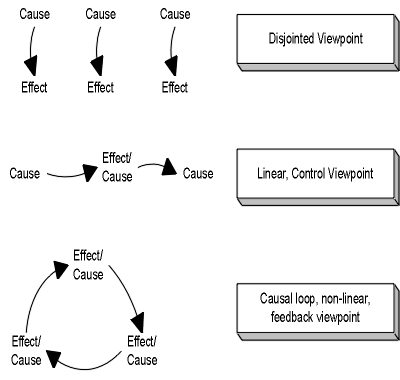
We all find such disjointed ideas to be unsound. But, and thisis important to understand, many people cling to such simple,disconnected cause and effect ideas just because of theirsimplicity. The world, they say, is just too complex to predict.Besides, "if we took account of all those other dubiouseffects, we would never get anything done"(sic!). This, thenis the simplistic, reductionist world in which much of politicsand management wallows in self-deluding comfort.
Engineers know better. We know that cause produces effect, andthat effect will cause another effect further downstream. Weproduce project management plans to prove it. We rarely, if ever,check project outcomes against those original plans to see ifthey workedtoo embarrassing. This is the linear controlviewpoint. It dominates co-ordinated human planning and buildingactivities. It dominates engineering design. It is fundamental tolarge-scale physics, in their attempts to produce a Theory ofEverything. It was the basis of Pascals Clockwork Universe.It is positive, assertive, comforting and invariably wrong.
Why? Plain and simple, it ignores feedback.
The last figure in the diagram shows the basis of SystemsThinking. Effect follows from Cause. Any Effect is also anotherCause. And, inevitably in the real world, the cause-effect chainloops back upon itself to describe non-linear behaviour. Only thenon-linear causal loop explains the blotting paper, aileron,hunger reduction, eyes and ears, requirements and softwaredebugging, bio-chemical machines, multi-media transportinteractions, that roads cause traffic as much as trafficgenerates roads, and much, much more. Some loops mayreinforcethey are positive feedback loops. Some loops maycounteractthey are negative feedback loops. Most real worldproblems invoke several, coupled loops, some positive, othersnegative. Each loop might, separately, be quite simple. Put themall together and the whole may behavecounter-intuitivelyemergence and complex behaviour!
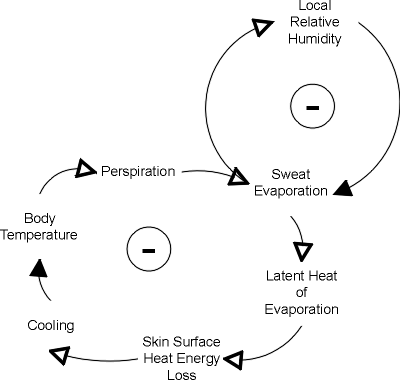
Looking around for a nice example to finish this epistle, howabout this Causal Loop Model (CLM) as I sit sweltering in 31°C?It comprises two interacting loops, seeking to explain how I ammanaging to sit here and not totally melt. First the symbology.Open-headed arrows mean "A causes, or acts in sympathy with,B". Solid-head arrows mean "A opposes, or counteractsB". Both loops have a minus sign in their centres,indicating negative feedback.
Simple? Yes, but it should be as a first example. You canstart to apply the model, too. What happens to someone lost in adesert without water? Should a marathon runner, who is about torun in a very humid environment, drink more, or less water thanusual? You can expand the model. What happens when bodytemperature drops? And if you think that this has nothing to dowith systems engineering, then change your medication.
Ill be back
Derek Hitchins
A message from Steve Mallon, your {frustrated|allpowerful|ever receptive} webmaster.
This is a gentle reminder that some time ago I set up adiscussion area on our web site, which has now accumulated thestaggering total of three messages :-(
Now either your are unable to use this facility, too shy touse it, or don't think it's worth the trouble, or there is atechnical fault.
One of the problems for the chapter has always been thatgeography and other factors makes frequent physical meetingsdifficult. The web site and the discussion area in particularwere seen a steps towards effective use of the internet tofacilitate useful activity within the chapter.
A discussion area with three messages in as many months ishardly likely to impress new visitors. Consequently if it's notseeing more use in the next few weeks, it will disappear in apuff of [virtual] smoke.
So come on, how about some messages. Perhaps those of you whowent to INCOSE 97 in LA could get things going with a fewthoughts on what they saw? Any views on the web site and itsfuture use would also be welcome.
Visit the Web site and make Steves day athttp//www.incose.org.uk. Contact Steve . Use it or lose it!
The British Psychological Society (BPS) has formed a SpecialInterest Group (SIG) on Engineering Psychology. This SIG isconcerned with areas of system design that are commonly groupedunder the title of Usability. The SIG approached INCOSE UKearlier this year to see if we had interests in common and if sowhat we could do jointly to further them. We quickly agreed thatwe had and that the most practicable ways of helping each otherare:
This is a general approach that we have developed which issuitable for working with any organisation representing adiscipline that interacts with SE. In the case of the Associationof Project Managers (APM), the relationship has developed to thepoint where they have presented a paper at our symposium; we havepresented two papers at one of their regional meetings and now weare considering organising a joint event next year.
If you have contact with another organisation representing afunctional discipline with which systems engineering has asignificant interaction please advise any member of the Board orthe SEPDC.
Mike Prince
When the UK Chapter of INCOSE was established a number ofInterest Groups were set up to hammer out UK views on matterssuch as principles, processes and project management. Despiteinitial enthusiasm and various attempts at reorganising thegroups to meet changing perceptions, it became more and moredifficult to achieve good attendance at meetings and theactivities petered out.
At Luton I was asked; "Whatever happened to the InterestGroups? We really need the answers to some of the issues theywere trying to address.". The answer is that they have beenparked for the moment until we can find a way of resourcing themwhich is more acceptable to those who pay for the time andexpenses of participants.
One possible answer to limit the Interest Groups in variousways, e.g.:
If you have a systems engineering issue which is not specificto your organization and which would benefit from discussion withother members with different perspectives why not considersetting up an Interest Group in your vicinity to address it.Please register your Group, its objective and programme ofmeetings with the SEPDC and do ask if there is any way in whichyou think we may be able to help you. Help might take the form ofattendance of a Board member to show INCOSE UK endorsement,assistance in obtaining an expert speaker, or simply advice onorganizing meetings. John Mead, our administrator, can also helpwith regionalised membership lists and possibly membersinterests lists.
Mike Prince
Many members will be aware of the Foresight Programme whichwas announced in the 1993 White Paper "Realising OurPotential". One of the selected topics for study was SystemsEngineering and INCOSE, together with IEE, took a leading role inthis activity. The "Building Integrated Systems" reportof the Defence and Aerospace Foresight Panel Technology WorkingParty was launched by the Governments Chief ScientificAdvisor during July. It contains some sweeping recommendationsfor change to our national approach to SE.
To encourage debate and to establish the views of members,DERA and INCOSE, have offered a limited number of copies free tomembers who are proposing to attend the forthcoming AGM. Thisdocument is also available from the IEE, P.O. Box 96, Stevenage,Herts, SG1 2SD for the sum of £30 net.
Also available is "The Systems Engineering ResearchFramework" report which was commissioned by the SE WorkingParty Defence and Aerospace Panel. Available for the sum of £10.plus £1 postage & packing from Professor J T Boardman, DeMontfort University, SERC, Hawthorn Building, The Gateway,Leicester, LE1 9BH.
Programme and registration details of the above event havebeen circulated to all UK Chapter members and it is mentionedelsewhere in the newsletter.
What you may not know is that there is considerable interestin this symposium, not just in Europe, but in the States as well.Peter Brook has reported strong interest at LA and Eric Honour,INCOSE President, has now asked for the programme andregistration document to be mailshotted to every US andnon-European member.
The bottom line is this. The conference facilities are limitedto about 300 delegates. UK members have the first opportunity toregister, by their earlier notice, so if youre planning toattend, register NOW!!
Amongst other things, the Luton Symposium revealed a stronginterest in Education and Training in the membership. An ad hocgroup of 25 or so members met at lunch time on the second day toregister their interest and discuss first steps. The consensusquickly emerged that in terms of priorities for attention,progress with Educational matters was far more important thanTraining.
I agreed to facilitate the formation of an Interest Group. Theplan was to give until the end of June for receipt of thoughts,details of present courses and other E&T material availableand to disseminate this during July, prior to calling a meetingwhen matters could be taken further at a formative IG meeting.
I am late with getting materials out to those who expressed aninterest. However, I also did not get as much material forcirculation as I had hoped for. I will now wait until the middleof September before copying everything received and circulatingthis to those who registered an interest. I guess we could planon having a first meeting in October, perhaps together with theAGM Event. For me, the first priority is to find a chairperson tohand the initiative over to! Any volunteers please step forward.
I had also put the matter up for discussion on the UK INCOSEweb site. So far, I have only received one further expression ofinterest.
My apologies to all of those members interested, for nothaving maintained the momentum that this subject deserves.
Allen Fairbairn
You will, by now, all have seen the programme for the aboveevent. We hope you like it.
The number of papers submitted was very encouraging and wellahead of the number that could be accommodated. The abstractspromise a very high standard, and many hours were required toagree what could be left out.
The UK submitted by far the highest number of papers but therewere also several each from France, Germany, Netherlands and USA.Smaller numbers were submitted by several other European nationsso we are looking forward to a very International view on thetheme. There are also nine invited papers.
The main theme of the event is about learning from each other,i.e. across business or industry sectors and we have a good rangerepresented to enable this to be achieved.
In order to turn down the minimum, and ensure all sectors wererepresented we had to persuade our hosts at ESTEC to run parallelsessions on the second day.
The facility at Noordwijk is large and modern and wellequipped with all the facilities that we are likely to need.Noordwijk is the Dutch equivalent of Brighton some say. It iscertainly on the coast and apart from sea and sand it principallycomprises a wide range of hotel accommodation.
We look forward to there being a good contingent from UK , inthe same way that we submitted the majority of papers. It is notgoing to be expensive, even including travel costs.
If for any reason your copy of the programme has not arrivedthrough your letter box, and you would like another, or can thinkof some other SE practitioner who may be interested in attendingplease let me know.
John Mead, The Rest, 20 Beehive Lane, Binfield, Berks, RG128TU. Tel:01344 422325, Fax: 01344 481035, e-mail: .
Please send any contributions to thisNewsletter to The Editor, INCOSE UK Newsletter, c/o Peter Lister,Aerosystems International Ltd., West Hendford, Yeovil, BA20 2AL.
Tel: 01935 443000 Fax: 01935 443111 e-mail:
This Newsletter is duplicated using thefacilities of Aerosystems International by kind permission of theOperations Manager












Last Updated: 23 January, 2000