The Autumn Assembly 2003










Smarter Systems Engineering
Held on 10-11th November 2003 at Milton Keynes
Overall Summary: The above event took place at the Kents Hill Park Conference and Training Centre in Milton Keynes with a contingent of 80 members enjoying a total of 6 sessions over two days. The organisers were very pleased with this because on 26 th October with just two weeks to go we had a total of 21 and just over a week later on 4 th November with only 3 working days left we had a grand total of 24 registered. We must do it earlier next time! Heard this before?
The Support Shop in Bracknell who do the registrations for us sent everyone that booked in time directions of how to find Kents Hill Park. You may gather from the number that only booked in at the last minute there were quite a number who did not get their directions and spent some time exploring Milton Keynes streets and more who explored nearly every corner of Kents Hill ( not Kents Hill Park) housing estate. I know that the latter can be a lot of fun because I did when investigating the place initially.
That apart I believe that every one enjoyed the venue, especially having class room style layout in the presentation rooms with dual projection screens in the main room. However, as I said before the event, the venue is not a hotel so do not expect room service. Someone I notice did ask for it, and got it but they were left understanding not to try it again. The responses from the questionnaires indicate excellent marks against every aspect of the venue and the main room audio visual had more excellent than good.
Perhaps we spoil people at our Spring Symposium giving them handbooks and copies of all ( that we can get in time) presentations on CD because even though, in response to a number of requests, we produced a handbook at the last minute it was not really appreciated people wanted more. At the Autumn Assembly we expect members to contribute, participate, and network and they still want it all written down for them. We sought, not very successfully, to have a volunteer rapporteur for each session, to compile a summary and critique of it for later publication and to give something to those that were unable to attend. However you will find most sessions reported upon, probably here and in the newsletter mainly by the session chairs I believe.
Thanks to all of you (30 odd out of 80) that completed and returned the symposium improvement questionnaire forms. We really do take note of what is said although we cannot please everyone because requests are often contradictory. I hear that the 45minute tea and coffee breaks, which were in response to earlier requests were very popular with just about everyone. We have not done a close review of the questionnaires yet except in the area of what topics would you like to see at future events. I have extracted all of these and passed them onto Dipesh for consideration in planning the next event. Have you volunteered to help him?
We were pleased that double tracks worked pretty well with the split of members being almost exactly in half. I will not comment on individual sessions as others are busy doing this for the newsletter, if they are done in time, if not then for the website. The AGM is reported upon separately in this newsletter. As already stated there was a great deal of approval for the venue and I think that this is the first event ever where no one has complained about the chairs being uncomfortable.
Our dinner was well attended with 60 in a room accommodating only 64 and there were complimentary remarks about the food. We were rather let down by not having an after dinner speaker but managed to provide our own entertainment.
It seems to me that on all accounts, apart perhaps other than attendance, this was another successful event. Certainly from what I hear it was an enjoyable one and a very informative one.
Now to start on the Spring Symposium it is only five months away! John Mead
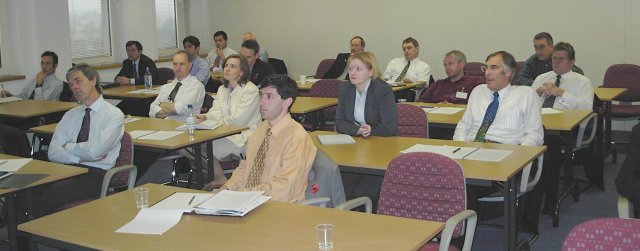
Session 1 Standards Review:
Stuart Arnold presented his views as the Editor of ISO/IEC 15288 on the technical, commercial and political drivers that led to the publication of the first International Standard on systems engineering at the close of 2002. He described the scope, and some of the standards design detail, against the background of system and organisational models that it employs. He explained why he believes that its profiled set of system-driven business processes now provides a more relevant and coherent view of systems engineering in the context of todays international trading environment.
Stuart provided the early evidence that the standard has strategic importance for organisations. He explained that ISO/IEC 15288 influences not just an organisations technical practices, but also its management practice and even its policies.
Drawing on many years of Thales experience in process improvement using capability maturity models, Trevor Rudge presented the CMMi scene to the meeting. He traced from the reasoning for its introduction through to its current application, and showed revealing figures on the progressive productivity and quality improvements that had been measured over this time.
Trevor balanced the more obvious benefits of applying maturity models by describing areas where the new users of CMMi need to be heedful. The message was that the effective application of maturity models has evolved to a point where quantifiable returns can be demonstrated, and that structured improvement of systems engineering is no longer theory but practice.
Some presentations are available:
-
CMMI: St George or the Dragon (ppt, 418kB), by Trevor Rudge, Thales
-
Systems Engineering In Defence Projects (ppt, 1.3MB) by Paul Davies, Thales Airborne Systems UK
-
System Evaluation & Measurement Introduction (ppt, 75kB) by Andrew Jaw
-
System Evaluation & Measurement Paper (ppt, 480kB) by Andrew Jaw
- How can Systems Engineering use System Dynamics? (ppt, 133kB) by Michael Kennedy South Bank University and David Exelby HVR Consulting Services
-
Qualitative Modelling for Requirements Engineering (ppt, 349kB) by Steve McIntosh - Cardiff University -
Challenges of System Dynamics to Deliver Requirements Engineering Projects: faster, better and cheaper
(ppt, 314kB) by Ddembe Williams of London South Bank University (UK)
-
Integrated System Evaluation Strategy Development
(zip, 1.5MB) by Mark Waddington, QinetiQ Test & Evaluation Services
And three recent additions:
- Introducing a Systems Engineering approach to a Railway Infrastructure project (ppt, 3.3MB) by Mark Irving of Atkins Rail
- Comparison of Two Evolving pan-European Standards (ppt, 101kB) by Euro-Interlocking & ASAAC
-
SE Skills in Different Application Domains - Introduction to Session
(ppt, 90kB) by Peter Lister, Siemens Transportation Systems
More photos are available.